琊 (yá) means "Part of the place name Langya" in Chinese. It has 10 strokes with the radical 王.
Rated 4.2/5 in difficulty (advanced).
Appears in 3+ common words including 琅琊 (láng yá), 琅琊榜 (láng yá bǎng), 琅琊山 (láng yá shān).
Due to its 10 strokes, Hanzi Writer's error detection shows 琊 requires focused practice — most learners need 10+ attempts for consistent accuracy.
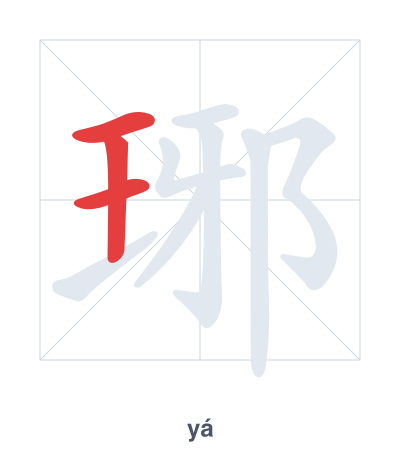
Open Hanzi Writer to see the animated stroke order and practice writing 琊 with real-time feedback.
The character 琊 (yá) is written with 10 strokes. Follow the standard Chinese stroke order: top to bottom, left to right, outside before inside. The radical 王 is one of its key components.
Practice the correct stroke order with the Hanzi Writer app to see animated stroke-by-stroke guidance with real-time feedback.
琊 means Part of the place name Langya.
琊 combines the jade radical 王 (originally three jade beads strung together) with 邪 (yá, meaning 'slanted' or 'evil'). In ancient times, this character referred to a type of jade or a jade ornament, but today it survives almost exclusively in the place name Langya (琅琊), a historical region in modern Shandong.
💡 Memory Tip: Picture a jade king (王) standing crookedly (邪) on a cliff—that's the place called 琊, Langya.
琅琊是一个古老的地名。
láng yá shì yí gè gǔ lǎo de dì míng
Langya is an ancient place name.
我喜欢看电视剧《琅琊榜》。
wǒ xǐ huān kàn diàn shì jù láng yá bǎng
I like watching the TV series 'Nirvana in Fire'.
我们明天去爬琅琊山。
wǒ men míng tiān qù pá láng yá shān
We are going to climb Langya Mountain tomorrow.
Open Hanzi Writer to see the animated stroke order and practice writing 琊 with real-time feedback.
✨ Animated stroke order · Handwriting recognition · HSK-graded practice · Free to use
琊 is made of the radical 王 (jade) on the left and the phonetic component 牙 (yá, tooth) on the right. Although 王 suggests jade, the character is not used for jade but exclusively as part of the place name 琅琊. The 牙 component gives the pronunciation yá.