莶 (xiān) means "Siegesbeckia (a medicinal herb)" in Chinese. It has 10 strokes with the radical 艹.
Rated 4.2/5 in difficulty (advanced).
Appears in 3+ common words including 豨莶 (xī xiān), 莶草 (xiān cǎo), 莶药 (xiān yào).
Due to its 10 strokes, Hanzi Writer's error detection shows 莶 requires focused practice — most learners need 10+ attempts for consistent accuracy.
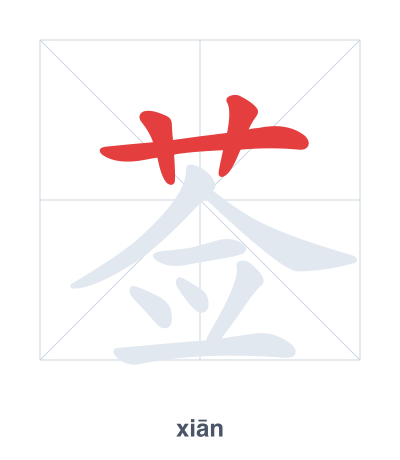
Open Hanzi Writer to see the animated stroke order and practice writing 莶 with real-time feedback.
The character 莶 (xiān) is written with 10 strokes. Follow the standard Chinese stroke order: top to bottom, left to right, outside before inside. The radical 艹 is one of its key components.
Practice the correct stroke order with the Hanzi Writer app to see animated stroke-by-stroke guidance with real-time feedback.
莶 means Siegesbeckia (a medicinal herb).
莶 is a phono-semantic compound. The radical 艹 (grass) indicates it is a plant, while 佥 (qiān, meaning 'all' or 'together') provides the sound. Together, they refer to the medicinal herb Siegesbeckia, known for its clustered leaves and healing properties.
💡 Memory Tip: Imagine a grass (艹) plant where all (佥) the leaves are bundled tightly together, like a medicinal herb ready for brewing.
豨莶是一种草药。
xī xiān shì yī zhǒng cǎo yào
Siegesbeckia is a type of herbal medicine.
莶草生长在路边。
xiān cǎo shēng zhǎng zài lù biān
Siegesbeckia grows by the roadside.
莶药可以治病。
xiān yào kě yǐ zhì bìng
Siegesbeckia medicine can treat diseases.
Open Hanzi Writer to see the animated stroke order and practice writing 莶 with real-time feedback.
✨ Animated stroke order · Handwriting recognition · HSK-graded practice · Free to use
The character 莶 is made of two parts: the radical 艹 (grass) on top and the component 佥 (qiān) below. The grass radical indicates the character relates to plants, specifically herbs. The lower part gives the sound, though the actual pinyin is xiān, not qiān.