尉 (wèi/yù) means "Military officer rank (e.g., Captain or Lieutenant)" in Chinese. It has 11 strokes with the radical 寸.
Rated 4.2/5 in difficulty (advanced).
Appears in 2+ common words including 尉官 (wèi guān), 尉迟 (yù chí).
Due to its 11 strokes, Hanzi Writer's error detection shows 尉 requires focused practice — most learners need 10+ attempts for consistent accuracy.
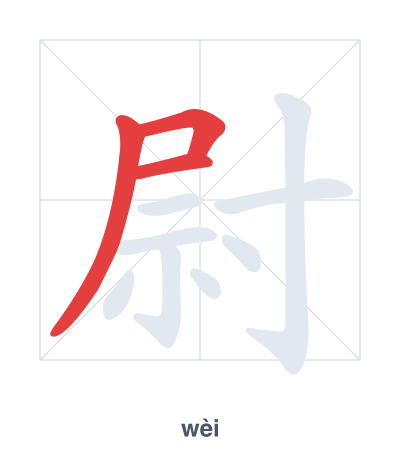
Open Hanzi Writer to see the animated stroke order and practice writing 尉 with real-time feedback.
The character 尉 (wèi/yù) is written with 11 strokes. Follow the standard Chinese stroke order: top to bottom, left to right, outside before inside. The radical 寸 is one of its key components.
Practice the correct stroke order with the Hanzi Writer app to see animated stroke-by-stroke guidance with real-time feedback.
尉 means Military officer rank (e.g., Captain or Lieutenant).
This is a polyphonic character with readings: wèi, yù.
| Character | 尉 |
| Pinyin | wèi / yù (wei/yu) |
| Meaning | Military officer rank (e.g., Captain or Lieutenant) |
| Strokes | 11 |
| Radical | 寸 |
| Difficulty | 4.2/5 |
Originally a compound showing a hand (寸) pressing an ironing tool over cloth (尸 and 示), 尉 meant 'to press' or 'to smooth.' This pressing action was extended to military officers who 'press' troops into order, leading to its rank meaning of captain or lieutenant.
💡 Memory Tip: Picture a lieutenant (尉) with a flag (尸) and a medal (示), raising his hand (寸) to command his troops.
这位尉官在演习中表现出色,受到了嘉奖。
zhè wèi wèi guān zài yǎn xí zhōng biǎo xiàn chū sè shòu dào le jiā jiǎng
This junior officer performed excellently in the exercise and received a commendation.
尉迟是一个在中国历史记载中非常有名的姓氏。
yù chí shì yí gè zài zhōng guó lì shǐ jì zǎi zhōng fēi cháng yǒu míng de xìng shì
Yuchi is a very famous surname in Chinese historical records.
Open Hanzi Writer to see the animated stroke order and practice writing 尉 with real-time feedback.
✨ Animated stroke order · Handwriting recognition · HSK-graded practice · Free to use
尉 is composed of three parts: 尸 (corpse), 示 (altar), and 寸 (hand). The 寸 component often symbolizes authority or measurement, which connects to the idea of a military officer who commands and enforces order. The left side 尸+示 may represent a ceremonial scene, reinforcing the officer's role in formal military rituals.