坨 (tuó) means "lump / heap / mound" in Chinese. It has 8 strokes with the radical 土.
Rated 3.7/5 in difficulty (challenging).
Appears in 3+ common words including 一坨 (yī tuó), 坨子 (tuó zi), 秤坨 (chèng tuó).
Due to its 8 strokes, Hanzi Writer's error detection shows 坨 requires focused practice — most learners need 10+ attempts for consistent accuracy.
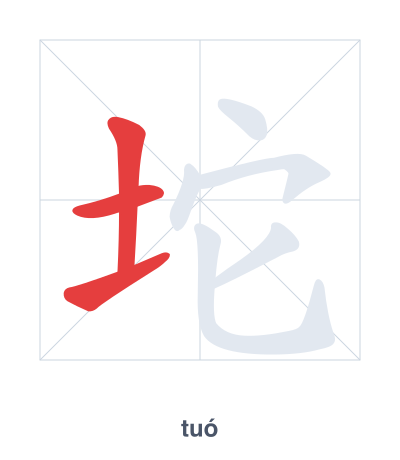
Open Hanzi Writer to see the animated stroke order and practice writing 坨 with real-time feedback.
The character 坨 (tuó) is written with 8 strokes. Follow the standard Chinese stroke order: top to bottom, left to right, outside before inside. The radical 土 is one of its key components.
Practice the correct stroke order with the Hanzi Writer app to see animated stroke-by-stroke guidance with real-time feedback.
坨 means lump / heap / mound.
坨 is a phono-semantic compound: the radical 土 (earth) indicates it relates to soil or mounds, while 它 (tā) provides the pronunciation and originally depicted a snake, but here it purely acts as a phonetic. Together, they form the meaning of a 'lump' or 'heap' of earth.
💡 Memory Tip: Picture a mound of dirt (土) with a snake (它) coiled on top, forming a lumpy heap.
地上有一坨泥巴。
dì shàng yǒu yī tuó ní bā
There is a lump of mud on the ground.
面粉结成了小坨子。
miàn fěn jié chéng le xiǎo tuó zi
The flour has formed small lumps.
秤坨掉在脚边了。
chèng tuó diào zài jiǎo biān le
The scale weight fell by the feet.
Open Hanzi Writer to see the animated stroke order and practice writing 坨 with real-time feedback.
✨ Animated stroke order · Handwriting recognition · HSK-graded practice · Free to use
The character 坨 is made of the radical 土 (earth) on the left and the phonetic component 它 (it, pronounced tuō) on the right. The earth radical hints that the meaning involves soil or dirt, while 它 gives the pronunciation and adds the idea of a "lump" or "heap" of something.