铄 (shuò) means "to melt / brilliant" in Chinese. It has 10 strokes with the radical 钅.
Rated 4.2/5 in difficulty (advanced).
Appears in 3+ common words including 铄金 (shuò jīn), 闪铄 (shǎn shuò), 铄亮 (shuò liàng).
Due to its 10 strokes, Hanzi Writer's error detection shows 铄 requires focused practice — most learners need 10+ attempts for consistent accuracy.
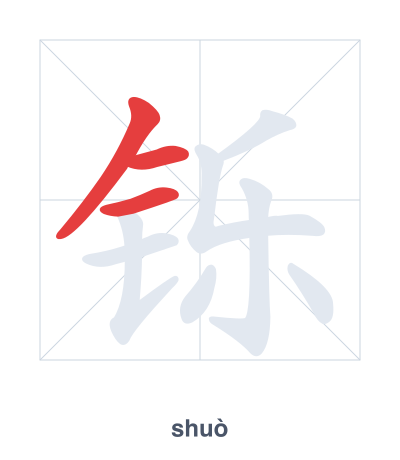
Open Hanzi Writer to see the animated stroke order and practice writing 铄 with real-time feedback.
The character 铄 (shuò) is written with 10 strokes. Follow the standard Chinese stroke order: top to bottom, left to right, outside before inside. The radical 钅 is one of its key components.
Practice the correct stroke order with the Hanzi Writer app to see animated stroke-by-stroke guidance with real-time feedback.
铄 means to melt / brilliant.
铄 is a phono-semantic compound: the radical 钅 (metal) indicates its connection to smelting and brilliance, while 乐 (yuè, 'music') supplies the pronunciation. The character originally described the melting of metal, later extended to mean 'brilliant' like the dazzling shimmer of molten metal.
💡 Memory Tip: Picture a melting metal bell (钅) emitting a brilliant, musical glow (乐) as it liquefies.
众口铄金。
zhòng kǒu shuò jīn
Public opinion is powerful enough to melt metal.
星星在闪铄。
xīng xīng zài shǎn shuò
Stars are twinkling.
他的眼睛很铄亮。
tā de yǎn jīng hěn shuò liàng
His eyes are very bright and shining.
Open Hanzi Writer to see the animated stroke order and practice writing 铄 with real-time feedback.
✨ Animated stroke order · Handwriting recognition · HSK-graded practice · Free to use
The character 铄 combines the radical 钅 (gold/metal) on the left with 乐 (music) on the right. The metal radical connects the character to melting metal or shiny metal surfaces, while 乐 provides the pronunciation shuò. Together they represent the ideas of melting or brilliance.