舜 (shùn) means "Shun (a legendary Chinese monarch)" in Chinese. It has 12 strokes with the radical 舛.
Rated 4.2/5 in difficulty (advanced).
Appears in 3+ common words including 尧舜 (yáo shùn), 舜帝 (shùn dì), 虞舜 (yú shùn).
Due to its 12 strokes, Hanzi Writer's error detection shows 舜 requires focused practice — most learners need 10+ attempts for consistent accuracy.
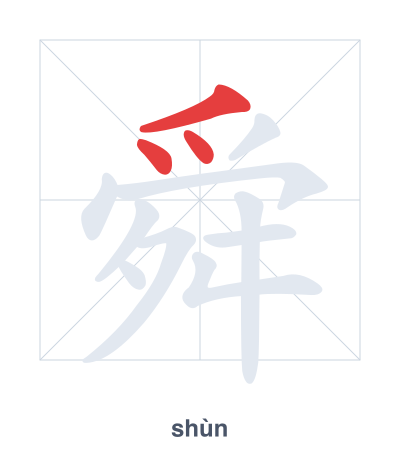
Open Hanzi Writer to see the animated stroke order and practice writing 舜 with real-time feedback.
The character 舜 (shùn) is written with 12 strokes. Follow the standard Chinese stroke order: top to bottom, left to right, outside before inside. The radical 舛 is one of its key components.
Practice the correct stroke order with the Hanzi Writer app to see animated stroke-by-stroke guidance with real-time feedback.
舜 means Shun (a legendary Chinese monarch).
| Character | 舜 |
| Pinyin | shùn (shun) |
| Meaning | Shun (a legendary Chinese monarch) |
| Strokes | 12 |
| Radical | 舛 |
| Difficulty | 4.2/5 |
舜 originally depicted a flowering plant, likely a type of hibiscus, but was borrowed to represent the legendary emperor Shun. The top part resembles a flower or crown, while the bottom component 舛 (opposing feet) suggests movement or action, alluding to Shun's virtuous and diligent rule.
💡 Memory Tip: Picture Emperor Shun balancing a crown (top) on two mismatched feet (舛) as he tirelessly travels to care for his people.
尧舜是古代的圣人。
yáo shùn shì gǔ dài de shèng rén
Yao and Shun are ancient sages.
舜帝的故事很有名。
shùn dì de gù shì hěn yǒu míng
The story of Emperor Shun is very famous.
虞舜是他的名字。
yú shùn shì tā de míng zì
Yu Shun is his name.
Open Hanzi Writer to see the animated stroke order and practice writing 舜 with real-time feedback.
✨ Animated stroke order · Handwriting recognition · HSK-graded practice · Free to use
舜 is composed of the radical 舛 on top, which means 'opposite feet,' and the component 夕 (evening) below. The radical 舛 suggests movement or stepping, reflecting the legendary ruler Shun's active role in governing. However, the overall character is used as a proper name, so the components primarily help with writing and memory rather than directly conveying meaning.