茕 (qióng) means "solitary" in Chinese. It has 8 strokes with the radical 艹.
Rated 3.7/5 in difficulty (challenging).
Appears in 3+ common words including 茕茕 (qióng qióng), 茕独 (qióng dú), 茕居 (qióng jū).
Due to its 8 strokes, Hanzi Writer's error detection shows 茕 requires focused practice — most learners need 10+ attempts for consistent accuracy.
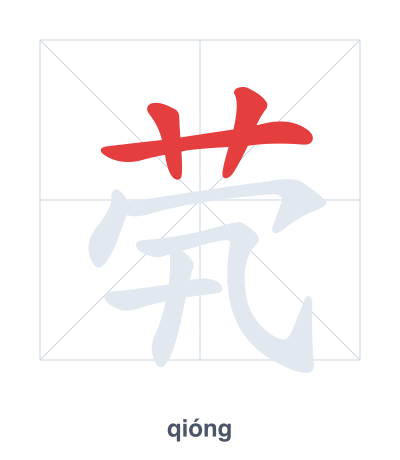
Open Hanzi Writer to see the animated stroke order and practice writing 茕 with real-time feedback.
The character 茕 (qióng) is written with 8 strokes. Follow the standard Chinese stroke order: top to bottom, left to right, outside before inside. The radical 艹 is one of its key components.
Practice the correct stroke order with the Hanzi Writer app to see animated stroke-by-stroke guidance with real-time feedback.
茕 means solitary.
The character 茕 combines the radical 艹 (grass) on top with a shelter (冖) enclosing 凡 (all). This composition evokes an image of a solitary grass plant growing alone under a covering, emphasizing the meaning of 'solitary' or 'alone'.
💡 Memory Tip: Picture a single blade of grass (艹) under a tiny roof (冖) all by itself (凡) — that lonely plant is '茕'.
他茕茕一人。
tā qióng qióng yī rén
He is all alone.
老人生活茕独。
lǎo rén shēng huó qióng dú
The elderly person lives a lonely and solitary life.
他在山中茕居。
tā zài shān zhōng qióng jū
He lives alone in the mountains.
Open Hanzi Writer to see the animated stroke order and practice writing 茕 with real-time feedback.
✨ Animated stroke order · Handwriting recognition · HSK-graded practice · Free to use
茕 consists of the grass radical 艹 on top, a cover 冖 in the middle, and a bottom part resembling 八. The components do not directly explain the meaning "solitary", but the grass radical may hint at something wild or isolated.