桤 (qī) means "Alder tree" in Chinese. It has 10 strokes with the radical 木.
Rated 4.2/5 in difficulty (advanced).
Appears in 3+ common words including 桤木 (qī mù), 桤树 (qī shù), 水桤 (shuǐ qī).
Due to its 10 strokes, Hanzi Writer's error detection shows 桤 requires focused practice — most learners need 10+ attempts for consistent accuracy.
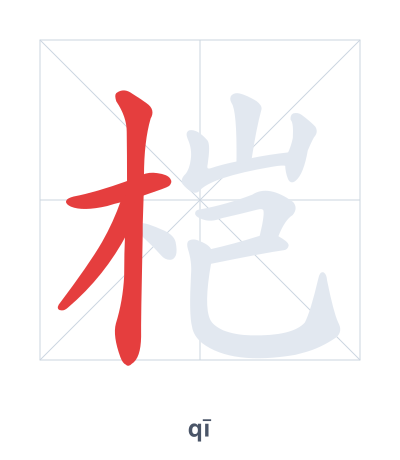
Open Hanzi Writer to see the animated stroke order and practice writing 桤 with real-time feedback.
The character 桤 (qī) is written with 10 strokes. Follow the standard Chinese stroke order: top to bottom, left to right, outside before inside. The radical 木 is one of its key components.
Practice the correct stroke order with the Hanzi Writer app to see animated stroke-by-stroke guidance with real-time feedback.
桤 means Alder tree.
This character is a phono-semantic compound: the radical 木 indicates it's a type of tree, and the component 岂 (qǐ) provides the pronunciation, so 桤 (qī) means 'alder tree'.
💡 Memory Tip: Imagine an alder tree (木) with a mountain peak (山) on its trunk and a coiled snake (己) at its base — that bizarre sight helps you recall 桤.
桤木长在河边。
qī mù zhǎng zài hé biān
Alder trees grow by the riverside.
院子里有一棵桤树。
yuàn zi lǐ yǒu yī kē qī shù
There is an alder tree in the yard.
水桤喜欢潮湿。
shuǐ qī xǐ huān cháo shī
Water alders like moisture.
Open Hanzi Writer to see the animated stroke order and practice writing 桤 with real-time feedback.
✨ Animated stroke order · Handwriting recognition · HSK-graded practice · Free to use
桤 is made of the radical 木 (tree) on the left and the phonetic component 岂 (qǐ) on the right. The 木 radical indicates it is a type of tree, while 岂 provides the sound hint for pronunciation, though it does not carry meaning about the alder tree itself.