钕 (nǚ) means "Neodymium" in Chinese. It has 8 strokes with the radical 钅.
Rated 3.7/5 in difficulty (challenging).
Appears in 3+ common words including 钕磁铁 (nǚ cí tiě), 钕元素 (nǚ yuán sù), 强力钕 (qiáng lì nǚ).
Due to its 8 strokes, Hanzi Writer's error detection shows 钕 requires focused practice — most learners need 10+ attempts for consistent accuracy.
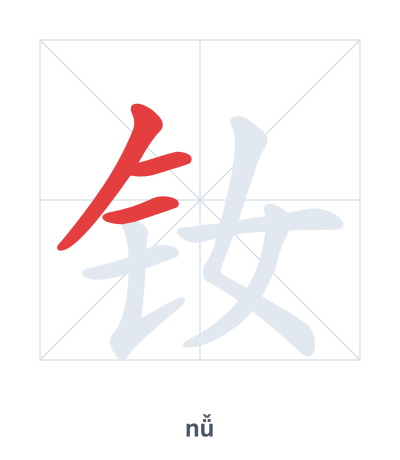
Open Hanzi Writer to see the animated stroke order and practice writing 钕 with real-time feedback.
The character 钕 (nǚ) is written with 8 strokes. Follow the standard Chinese stroke order: top to bottom, left to right, outside before inside. The radical 钅 is one of its key components.
Practice the correct stroke order with the Hanzi Writer app to see animated stroke-by-stroke guidance with real-time feedback.
钕 means Neodymium.
钕 is a phono-semantic compound: the radical 钅 (simplified form of 金, 'metal') indicates it's a metallic element, and the component 女 (nǚ, 'woman') provides the pronunciation. It was created in modern Chinese to represent the chemical element neodymium, following the pattern of naming metals with a metal radical and a phonetic part.
💡 Memory Tip: Imagine a woman (女) using a strong neodymium magnet (钅) to pick up metal objects.
这个磁铁是钕做的。
zhè ge cí tiě shì nǚ zuò de
This magnet is made of neodymium.
钕是一种化学元素。
nǚ shì yī zhǒng huà xué yuán sù
Neodymium is a chemical element.
强力钕磁铁很有用。
qiáng lì nǚ cí tiě hěn yǒu yòng
Strong neodymium magnets are very useful.
Open Hanzi Writer to see the animated stroke order and practice writing 钕 with real-time feedback.
✨ Animated stroke order · Handwriting recognition · HSK-graded practice · Free to use
The character 钕 is composed of the radical 钅 on the left, which means "metal" or "gold," and the phonetic component 女 (nǚ) on the right, which provides the sound. Since neodymium is a metallic element, the metal radical directly connects to its classification as a chemical element.