佞 (nìng) means "flattery; glib" in Chinese. It has 7 strokes with the radical 亻.
Rated 3.2/5 in difficulty (challenging).
Appears in 3+ common words including 佞臣 (nìng chén), 奸佞 (jiān nìng), 佞人 (nìng rén).
Due to its 7 strokes, Hanzi Writer's error detection shows 佞 requires focused practice — most learners need 10+ attempts for consistent accuracy.
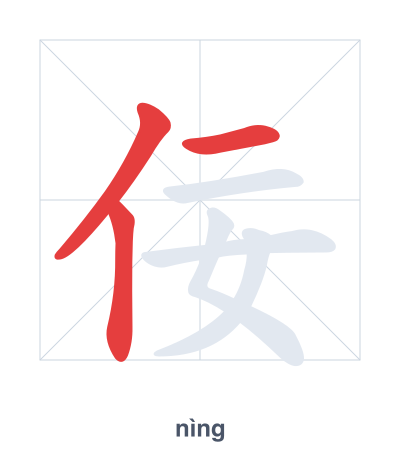
Open Hanzi Writer to see the animated stroke order and practice writing 佞 with real-time feedback.
The character 佞 (nìng) is written with 7 strokes. Follow the standard Chinese stroke order: top to bottom, left to right, outside before inside. The radical 亻 is one of its key components.
Practice the correct stroke order with the Hanzi Writer app to see animated stroke-by-stroke guidance with real-time feedback.
佞 means flattery; glib.
The character 佞 combines the person radical 亻 with a right side consisting of 二 (two) above 女 (woman). This structure suggests a person who speaks in two ways, like a flattering or double-tongued individual, originally meaning 'glib' or 'skilled in speech' but later taking on the negative connotation of flattery.
💡 Memory Tip: Imagine a person (亻) with two faces (二) flattering a woman (女) by saying sweet but dishonest things.
皇帝身边有佞臣。
huáng dì shēn biān yǒu nìng chén
There are sycophantic officials around the Emperor.
这是一个奸佞的人。
zhè shì yí gè jiān nìng de rén
This is a treacherous person.
不要相信佞人的话。
bú yào xiāng xìn nìng rén de huà
Don't believe the words of flatterers.
Open Hanzi Writer to see the animated stroke order and practice writing 佞 with real-time feedback.
✨ Animated stroke order · Handwriting recognition · HSK-graded practice · Free to use
The character 佞 is composed of the radical 亻 (person on the left) and the right part 仁 (which normally means 'benevolence' but here acts as a phonetic component). The radical 亻 ties the character to people, while the overall meaning of 'flattery' or 'glib talk' suggests a person who uses smooth, deceptive words.