苠 (mín) means "bamboo skin / numerous" in Chinese. It has 8 strokes with the radical 艹.
Rated 3.7/5 in difficulty (challenging).
Appears in 3+ common words including 苠苠 (mín mín), 苠原 (mín yuán), 庄稼苠 (zhuāng jià mín).
Due to its 8 strokes, Hanzi Writer's error detection shows 苠 requires focused practice — most learners need 10+ attempts for consistent accuracy.
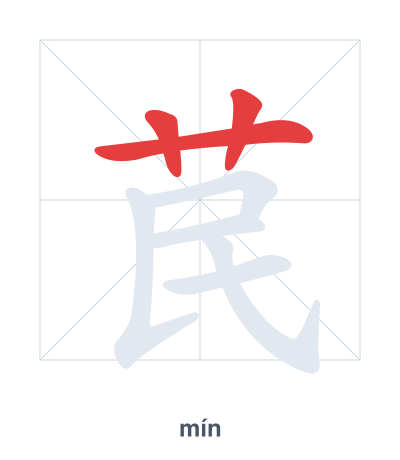
Open Hanzi Writer to see the animated stroke order and practice writing 苠 with real-time feedback.
The character 苠 (mín) is written with 8 strokes. Follow the standard Chinese stroke order: top to bottom, left to right, outside before inside. The radical 艹 is one of its key components.
Practice the correct stroke order with the Hanzi Writer app to see animated stroke-by-stroke guidance with real-time feedback.
苠 means bamboo skin / numerous.
苠 is a phono-semantic compound: the radical 艹 (grass) indicates a plant-related meaning, while 民 (mín, 'people') provides the pronunciation. Its original meaning refers to the inner skin of bamboo, a thin plant layer, and it can also mean 'numerous' in some contexts.
💡 Memory Tip: Picture a multitude of people (民) hiding under a blanket of grass (艹), representing the numerous layers of bamboo skin.
庄稼长得苠苠的。
zhuāng jià zhǎng dé mín mín de
The crops are growing lushly.
这片苠原很广阔。
zhè piàn mín yuán hěn guǎng kuò
This grassy plain is very vast.
今年的庄稼苠了。
jīn nián de zhuāng jià mín le
The crops are flourishing this year.
Open Hanzi Writer to see the animated stroke order and practice writing 苠 with real-time feedback.
✨ Animated stroke order · Handwriting recognition · HSK-graded practice · Free to use
The character 苠 consists of the radical 艹 (grass) on top and the phonetic component 民 (mín, people) below. The grass radical hints at its connection to plants, while 民 provides the sound. Combined, 苠 originally referred to bamboo skin or numerous plants, tying the grass meaning to the idea of abundance.