珉 (mín) means "jade-like stone" in Chinese. It has 9 strokes with the radical 王.
Rated 4/5 in difficulty (challenging).
Appears in 3+ common words including 珉石 (mín shí), 珉玉 (mín yù), 采珉 (cǎi mín).
Due to its 9 strokes, Hanzi Writer's error detection shows 珉 requires focused practice — most learners need 10+ attempts for consistent accuracy.
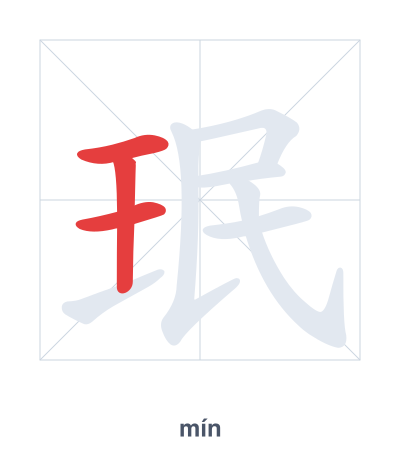
Open Hanzi Writer to see the animated stroke order and practice writing 珉 with real-time feedback.
The character 珉 (mín) is written with 9 strokes. Follow the standard Chinese stroke order: top to bottom, left to right, outside before inside. The radical 王 is one of its key components.
Practice the correct stroke order with the Hanzi Writer app to see animated stroke-by-stroke guidance with real-time feedback.
珉 means jade-like stone.
珉 is a phono-semantic compound: the left radical 王 (jade) indicates the material category, while the right component 民 (mín, meaning 'people') provides the pronunciation. Together they form the meaning 'jade-like stone,' a stone that resembles jade in appearance but is of lower value.
💡 Memory Tip: Imagine a commoner (民) proudly holding a piece of jade (王) that everyone admires, but it's actually just a humble stone pretending to be precious.
这块珉石很白。
zhè kuài mín shí hěn bái
This jade-like stone is very white.
珉玉不是真玉。
mín yù bú shì zhēn yù
Minyu is not real jade.
他去山里采珉。
tā qù shān lǐ cǎi mín
He went to the mountains to collect fine stones.
Open Hanzi Writer to see the animated stroke order and practice writing 珉 with real-time feedback.
✨ Animated stroke order · Handwriting recognition · HSK-graded practice · Free to use
珉 consists of the radical 王 (jade) on the left and the component 民 (mín, meaning 'people') on the right. The radical indicates that the character relates to jade or precious stones, while 民 provides the sound. Together, they mean a 'jade-like stone'.