礞 (méng) means "chlorite (a type of mineral)" in Chinese. It has 18 strokes with the radical 石.
Rated 4.2/5 in difficulty (advanced).
Appears in 3+ common words including 礞石 (méng shí), 青礞石 (qīng méng shí), 金礞石 (jīn méng shí).
Due to its 18 strokes, Hanzi Writer's error detection shows 礞 requires focused practice — most learners need 10+ attempts for consistent accuracy.
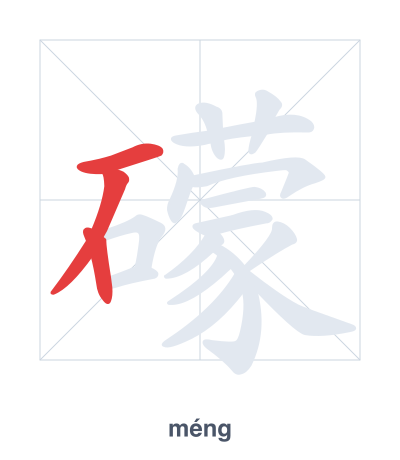
Open Hanzi Writer to see the animated stroke order and practice writing 礞 with real-time feedback.
The character 礞 (méng) is written with 18 strokes. Follow the standard Chinese stroke order: top to bottom, left to right, outside before inside. The radical 石 is one of its key components.
Practice the correct stroke order with the Hanzi Writer app to see animated stroke-by-stroke guidance with real-time feedback.
礞 means chlorite (a type of mineral).
This compound character combines the stone radical 石 (shí, 'stone/mineral') with 蒙 (méng, 'to cover, obscure'), suggesting a mineral that often forms as a covering layer or has a dull, earthy appearance—referring to chlorite schist.
💡 Memory Tip: Picture a stone (石) being covered (蒙) by a dull greenish film, revealing it as the mineral chlorite.
礞石是一种矿石。
méng shí shì yī zhǒng kuàng shí
Chlorite schist is a type of mineral.
青礞石可以做中药。
qīng méng shí kě yǐ zuò zhōng yào
Chlorite schist can be used as traditional Chinese medicine.
医生用了金礞石。
yī shēng yòng le jīn méng shí
The doctor used micaceous chlorite schist.
Open Hanzi Writer to see the animated stroke order and practice writing 礞 with real-time feedback.
✨ Animated stroke order · Handwriting recognition · HSK-graded practice · Free to use
礞 is composed of the radical 石 (stone) on the left and 蒙 (méng, meaning "to cover" or "dim") on the right. The stone radical indicates it is a type of mineral, while 蒙 suggests its appearance as a cloudy or covered stone, reflecting the mineral chlorite which often forms in layered, schist-like structures.