辂 (lù) means "Imperial carriage; large chariot" in Chinese. It has 10 strokes with the radical 车.
Rated 4.2/5 in difficulty (advanced).
Appears in 3+ common words including 辂车 (lù chē), 大辂 (dà lù), 宝辂 (bǎo lù).
Due to its 10 strokes, Hanzi Writer's error detection shows 辂 requires focused practice — most learners need 10+ attempts for consistent accuracy.
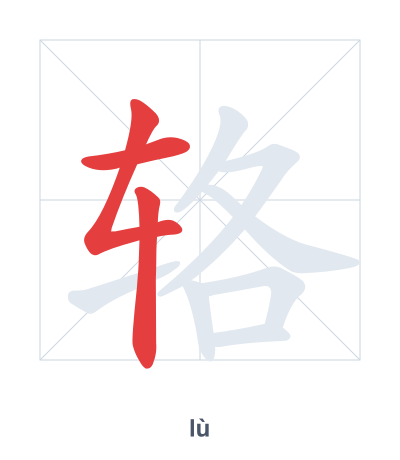
Open Hanzi Writer to see the animated stroke order and practice writing 辂 with real-time feedback.
The character 辂 (lù) is written with 10 strokes. Follow the standard Chinese stroke order: top to bottom, left to right, outside before inside. The radical 车 is one of its key components.
Practice the correct stroke order with the Hanzi Writer app to see animated stroke-by-stroke guidance with real-time feedback.
辂 means Imperial carriage; large chariot.
辂 is a phono-semantic compound: the radical 车 (chariot) indicates a vehicle, and 各 (gè) provides the sound. It specifically denotes a large, ceremonial imperial chariot used by nobility in ancient China.
💡 Memory Tip: Imagine each (各) imperial chariot (车) is so grand that it's called a 辂, rolling through the palace gates with majestic splendor.
这是一辆古代的辂车。
zhè shì yī liàng gǔ dài de lù chē
This is an ancient imperial carriage.
博物馆里有一辆大辂。
bó wù guǎn lǐ yǒu yī liàng dà lù
There is a large imperial carriage in the museum.
宝辂的装饰非常精美。
bǎo lù de zhuāng shì fēi cháng jīng měi
The decoration of the imperial carriage is very exquisite.
Open Hanzi Writer to see the animated stroke order and practice writing 辂 with real-time feedback.
✨ Animated stroke order · Handwriting recognition · HSK-graded practice · Free to use
辂 is a phono-semantic compound. The left side is 车 (chē, vehicle), which gives the meaning related to carriages. The right side is 各 (gè), which provides a phonetic clue for the pronunciation lù.