砻 (lóng) means "to hull (grain) / stone mill" in Chinese. It has 10 strokes with the radical 石.
Rated 4.2/5 in difficulty (advanced).
Appears in 3+ common words including 砻谷 (lóng gǔ), 砻磨 (lóng mó), 砻糠 (lóng kāng).
Due to its 10 strokes, Hanzi Writer's error detection shows 砻 requires focused practice — most learners need 10+ attempts for consistent accuracy.
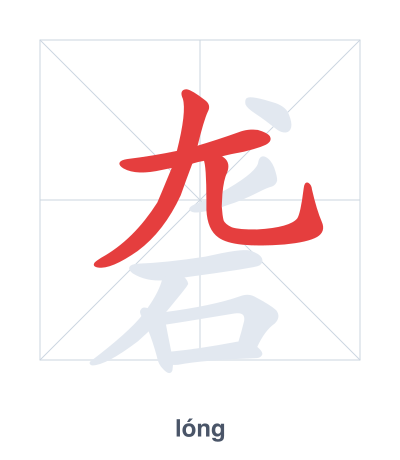
Open Hanzi Writer to see the animated stroke order and practice writing 砻 with real-time feedback.
The character 砻 (lóng) is written with 10 strokes. Follow the standard Chinese stroke order: top to bottom, left to right, outside before inside. The radical 石 is one of its key components.
Practice the correct stroke order with the Hanzi Writer app to see animated stroke-by-stroke guidance with real-time feedback.
砻 means to hull (grain) / stone mill.
砻 is a semantic-phonetic compound: the top 石 (stone) indicates the material of the mill, and the bottom 龙 (dragon) provides the pronunciation lóng while also evoking the circular, coiling motion of grinding grain.
💡 Memory Tip: Picture a stone dragon winding around a millstone, its scales scraping off grain husks as it turns.
农民在砻谷。
nóng mín zài lóng gǔ
Farmers are husking grain.
砻磨可以加工粮食。
lóng mó kě yǐ jiā gōng liáng shí
Hulling and grinding can process grain.
砻糠可以喂家禽。
lóng kāng kě yǐ wèi jiā qín
Rice husks can be used to feed poultry.
Open Hanzi Writer to see the animated stroke order and practice writing 砻 with real-time feedback.
✨ Animated stroke order · Handwriting recognition · HSK-graded practice · Free to use
The character 砻 has a top part 龙 (dragon) and a bottom part 石 (stone). The 石 radical indicates it relates to stone or grinding, while 龙 gives the sound lóng. Together, they form a word meaning a stone tool to hull grain.