锞 (kè) means "Ingot" in Chinese. It has 13 strokes with the radical 钅.
Rated 4.2/5 in difficulty (advanced).
Appears in 3+ common words including 锞子 (kè zi), 金锞子 (jīn kè zi), 银锞子 (yín kè zi).
Due to its 13 strokes, Hanzi Writer's error detection shows 锞 requires focused practice — most learners need 10+ attempts for consistent accuracy.
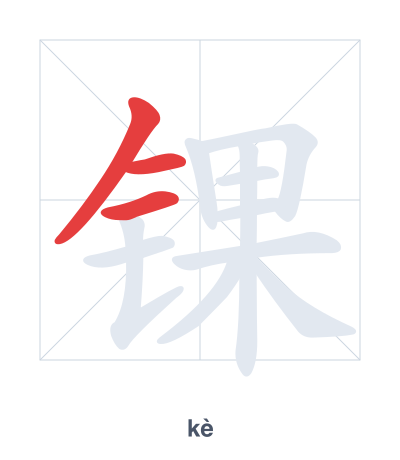
Open Hanzi Writer to see the animated stroke order and practice writing 锞 with real-time feedback.
The character 锞 (kè) is written with 13 strokes. Follow the standard Chinese stroke order: top to bottom, left to right, outside before inside. The radical 钅 is one of its key components.
Practice the correct stroke order with the Hanzi Writer app to see animated stroke-by-stroke guidance with real-time feedback.
锞 means Ingot.
锞 is a compound character with the metal radical 钅 indicating its metallic nature and the phonetic component 果 (fruit) suggesting pronunciation. Historically, ingots were small metal blocks used as currency, and the character combines the concept of metal with a sound akin to 'kè' from 果.
💡 Memory Tip: Imagine a metal fruit (果) shaped like a tiny gold ingot, heavy and valuable, sitting on a scale.
这是一个小锞子。
zhè shì yí gè xiǎo kè zi
This is a small silver or gold ingot.
他收到了一个金锞子。
tā shōu dào le yí gè jīn kè zi
He received a small gold ingot.
桌上放着银锞子。
zhuō shàng fàng zhe yín kè zi
There are silver ingots on the table.
Open Hanzi Writer to see the animated stroke order and practice writing 锞 with real-time feedback.
✨ Animated stroke order · Handwriting recognition · HSK-graded practice · Free to use
锞 is made of the radical 钅 (gold or metal) on the left and the character 果 (fruit) on the right. The 钅 radical tells you the character is related to metal, and 果 provides the pronunciation kè while also suggesting a small, solid shape like a fruit, which matches the meaning 'ingot'.