栲 (kǎo) means "Mangrove; Evergreen chinquapin" in Chinese. It has 10 strokes with the radical 木.
Rated 4.2/5 in difficulty (advanced).
Appears in 3+ common words including 栲栳 (kǎo lǎo), 栲胶 (kǎo jiāo), 栲绸 (kǎo chóu).
Due to its 10 strokes, Hanzi Writer's error detection shows 栲 requires focused practice — most learners need 10+ attempts for consistent accuracy.
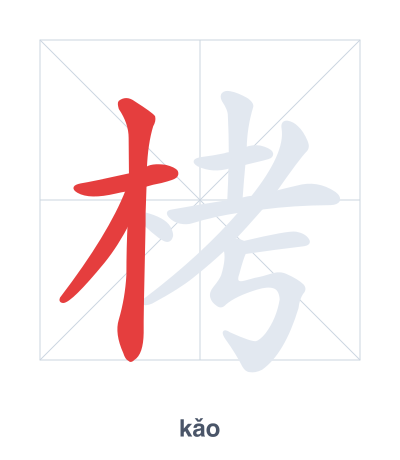
Open Hanzi Writer to see the animated stroke order and practice writing 栲 with real-time feedback.
The character 栲 (kǎo) is written with 10 strokes. Follow the standard Chinese stroke order: top to bottom, left to right, outside before inside. The radical 木 is one of its key components.
Practice the correct stroke order with the Hanzi Writer app to see animated stroke-by-stroke guidance with real-time feedback.
栲 means Mangrove; Evergreen chinquapin.
栲 is a phono-semantic compound: the radical 木 (tree) hints that it refers to a type of tree, while 考 (kǎo, meaning 'to test' or 'examine') provides the pronunciation. The character denotes specific evergreen trees like the mangrove or chinquapin, which were historically used for making tool handles and fire‑resistant materials.
💡 Memory Tip: Picture a scholar sitting under a tree (木) frantically cramming for an exam (考), but the tree is a tough, twisted mangrove that refuses to give him shade.
这是一个竹编的栲栳。
zhè shì yí gè zhú biān de kǎo lǎo
This is a bamboo-woven basket.
这种树可以提取栲胶。
zhè zhòng shù kě yǐ tí qǔ kǎo jiāo
Tannin extract can be extracted from this tree.
她买了一件栲绸衣服。
tā mǎi le yī jiàn kǎo chóu yī fú
She bought a piece of pongee clothing.
Open Hanzi Writer to see the animated stroke order and practice writing 栲 with real-time feedback.
✨ Animated stroke order · Handwriting recognition · HSK-graded practice · Free to use
栲 combines the radical 木 (tree) on the left with the component 考 on the right. The 木 radical shows that the character refers to a type of tree, while 考 provides the pronunciation (kǎo) and originally carried no direct meaning. So 栲 names a specific tree, the evergreen chinquapin or mangrove.