旌 (jīng) means "banner, flag" in Chinese. It has 11 strokes with the radical 方.
Rated 4.2/5 in difficulty (advanced).
Appears in 3+ common words including 旌旗 (jīng qí), 旌表 (jīng biǎo), 旌德 (jīng dé).
Due to its 11 strokes, Hanzi Writer's error detection shows 旌 requires focused practice — most learners need 10+ attempts for consistent accuracy.
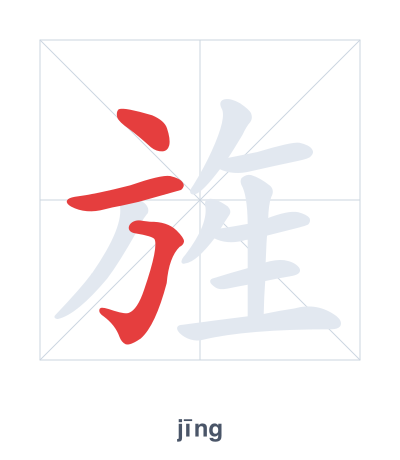
Open Hanzi Writer to see the animated stroke order and practice writing 旌 with real-time feedback.
The character 旌 (jīng) is written with 11 strokes. Follow the standard Chinese stroke order: top to bottom, left to right, outside before inside. The radical 方 is one of its key components.
Practice the correct stroke order with the Hanzi Writer app to see animated stroke-by-stroke guidance with real-time feedback.
旌 means banner, flag.
| Character | 旌 |
| Pinyin | jīng (jing) |
| Meaning | banner, flag |
| Strokes | 11 |
| Radical | 方 |
| Difficulty | 4.2/5 |
旌 combines 方 (a flagpole) with 㫃 (a banner with streamers), originally depicting a pole topped with feathers or tassels used as a signal or honorific flag in ancient China.
💡 Memory Tip: Picture a flagpole (方) where a person (人) raises a living plant (生) as a banner to celebrate a victory.
旌旗在空中飞舞。
jīng qí zài kōng zhōng fēi wǔ
Banners are dancing in the air.
政府旌表了他的行为。
zhèng fǔ jīng biǎo le tā de xíng wéi
The government commended his actions.
旌德是一个地名。
jīng dé shì yí gè dì míng
Jingde is a place name.
Open Hanzi Writer to see the animated stroke order and practice writing 旌 with real-time feedback.
✨ Animated stroke order · Handwriting recognition · HSK-graded practice · Free to use
旌 is composed of two parts: the radical 方 on the left, which relates to a flag or direction, and 生 above 人 on the right. The right side 生 originally meant 'to wave' or 'to flutter,' and together they create the image of a waving banner.