迦 (jiā) means "(Phonetic used in transliterations)" in Chinese. It has 8 strokes with the radical 辶.
Rated 3.7/5 in difficulty (challenging).
Appears in 3+ common words including 迦南 (jiā nán), 释迦 (shì jiā), 迦太基 (jiā tài jī).
Due to its 8 strokes, Hanzi Writer's error detection shows 迦 requires focused practice — most learners need 10+ attempts for consistent accuracy.
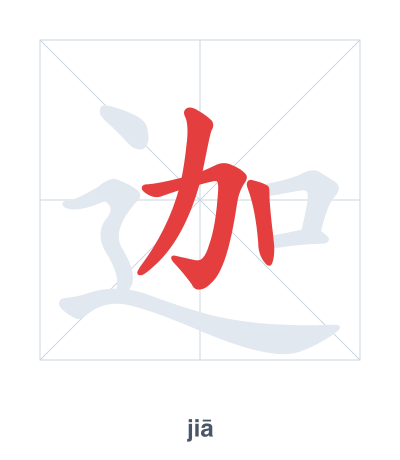
Open Hanzi Writer to see the animated stroke order and practice writing 迦 with real-time feedback.
The character 迦 (jiā) is written with 8 strokes. Follow the standard Chinese stroke order: top to bottom, left to right, outside before inside. The radical 辶 is one of its key components.
Practice the correct stroke order with the Hanzi Writer app to see animated stroke-by-stroke guidance with real-time feedback.
迦 means (Phonetic used in transliterations).
迦 is a phono-semantic compound where 辶 (walking) provides a vague sense of movement, and 加 (jiā) contributes the phonetic value. It was coined to transcribe foreign sounds, especially in Buddhist terms like 迦葉 (Mahākāśyapa).
💡 Memory Tip: Picture a walker (辶) adding (加) a weird sound 'jia' to pronounce a foreign name while strolling.
他去过迦南地。
tā qù guò jiā nán dì
He has been to the land of Canaan.
他在看释迦牟尼像。
tā zài kàn shì jiā mù ní xiàng
He is looking at the statue of Shakyamuni.
这是迦太基古城。
zhè shì jiā tài jī gǔ chéng
This is the ancient city of Carthage.
Open Hanzi Writer to see the animated stroke order and practice writing 迦 with real-time feedback.
✨ Animated stroke order · Handwriting recognition · HSK-graded practice · Free to use
迦 is a phonetic loan character composed of the radical 辶 (walk) and the phonetic component 加 (jiā). The radical 辶 hints at movement or travel, but 迦 does not have a literal meaning; it is used almost exclusively for transliterating foreign names and terms. The component 加 provides the sound jiā, making 迦 a sound-based character.