珈 (jiā) means "hair ornament" in Chinese. It has 9 strokes with the radical 王.
Rated 4/5 in difficulty (challenging).
Appears in 3+ common words including 珈琲 (jiā bèi), 珈玛 (jiā mǎ), 珞珈 (luò jiā).
Due to its 9 strokes, Hanzi Writer's error detection shows 珈 requires focused practice — most learners need 10+ attempts for consistent accuracy.
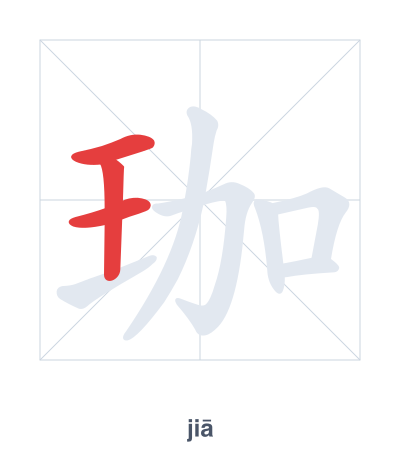
Open Hanzi Writer to see the animated stroke order and practice writing 珈 with real-time feedback.
The character 珈 (jiā) is written with 9 strokes. Follow the standard Chinese stroke order: top to bottom, left to right, outside before inside. The radical 王 is one of its key components.
Practice the correct stroke order with the Hanzi Writer app to see animated stroke-by-stroke guidance with real-time feedback.
珈 means hair ornament.
珈 is a compound character: the radical 王 (jade) indicates it is a jade ornament, while 加 (jiā, meaning 'to add') provides phonetic clues and suggests the ornament is 'added' to the hair. Ancient texts describe it as a hairpin or tiara worn by noblewomen, often made of jade or precious stones.
💡 Memory Tip: Picture a jade (王) hairpin with a plus sign (加) dangling from it, symbolizing how this ornament is 'added' to the hair for extra beauty.
他喜欢喝珈琲。
tā xǐ huān hē jiā bèi
He likes drinking coffee.
珈玛射线很强。
jiā mǎ shè xiàn hěn qiáng
Gamma rays are very strong.
珞珈山在武汉。
luò jiā shān zài wǔ hàn
Luojia Hill is in Wuhan.
Open Hanzi Writer to see the animated stroke order and practice writing 珈 with real-time feedback.
✨ Animated stroke order · Handwriting recognition · HSK-graded practice · Free to use
The character 珈 is made of 王 (jade radical) on the left and 加 (jiā, meaning 'add') on the right. The jade radical connects to the original meaning of a precious hair ornament, while 加 provides the pronunciation. Together they show a jade piece that is 'added' to the hair as decoration.