齑 (jī) means "fine powder" in Chinese. It has 15 strokes with the radical 齐.
Rated 3.8/5 in difficulty (challenging).
Appears in 3+ common words including 齑粉 (jī fěn), 齑面 (jī miàn), 姜齑 (jiāng jī).
Due to its 15 strokes, Hanzi Writer's error detection shows 齑 requires focused practice — most learners need 10+ attempts for consistent accuracy.
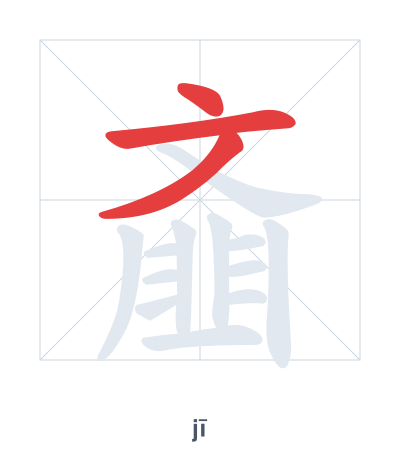
Open Hanzi Writer to see the animated stroke order and practice writing 齑 with real-time feedback.
The character 齑 (jī) is written with 15 strokes. Follow the standard Chinese stroke order: top to bottom, left to right, outside before inside. The radical 齐 is one of its key components.
Practice the correct stroke order with the Hanzi Writer app to see animated stroke-by-stroke guidance with real-time feedback.
齑 means fine powder.
| Character | 齑 |
| Pinyin | jī (ji) |
| Meaning | fine powder |
| Strokes | 15 |
| Radical | 齐 |
| Difficulty | 3.8/5 |
This compound character combines 齐 (neat, uniform) with 韭 (leek), originally referring to minced leeks made into a uniform paste, then extended to mean any fine powder or crushed substance.
💡 Memory Tip: Picture a row of sharp knives (齐) finely chopping leeks (韭) into a powdery pile.
碗摔成了齑粉。
wǎn shuāi chéng le jī fěn
The bowl was smashed to pieces.
饼干碎成了齑面。
bǐng gān suì chéng le jī miàn
The biscuits were crushed into fine powder.
他在吃姜齑。
tā zài chī jiāng jī
He is eating minced ginger.
Open Hanzi Writer to see the animated stroke order and practice writing 齑 with real-time feedback.
✨ Animated stroke order · Handwriting recognition · HSK-graded practice · Free to use
The character 齑 consists of the radical 齐 on top and 非 below. Originally, it included 韭 (leek) to suggest finely chopped leeks, which led to the meaning of fine powder. In the simplified form, 非 is used as a phonetic and structural component, though the connection to powder is less direct.