桦 (huà) means "Birch" in Chinese. It has 10 strokes with the radical 木.
Rated 4.2/5 in difficulty (advanced).
Appears in 3+ common words including 桦树 (huà shù), 白桦 (bái huà), 桦木 (huà mù).
Due to its 10 strokes, Hanzi Writer's error detection shows 桦 requires focused practice — most learners need 10+ attempts for consistent accuracy.
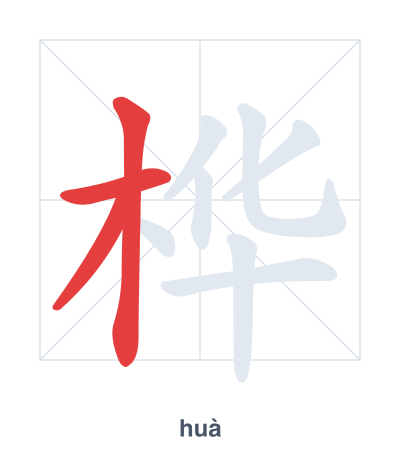
Open Hanzi Writer to see the animated stroke order and practice writing 桦 with real-time feedback.
The character 桦 (huà) is written with 10 strokes. Follow the standard Chinese stroke order: top to bottom, left to right, outside before inside. The radical 木 is one of its key components.
Practice the correct stroke order with the Hanzi Writer app to see animated stroke-by-stroke guidance with real-time feedback.
桦 means Birch.
桦 is a phono-semantic compound: the radical 木 indicates it's a tree, while 华 (huá, meaning 'splendid' or 'flower') provides the pronunciation and hints at the birch's striking white bark, which ancient Chinese poets often praised as elegant and flowery.
💡 Memory Tip: Picture a birch tree (木) wearing a flower crown (华) because its white bark is so splendid and showy.
桦树的叶子黄了。
huà shù de yè zi huáng le
The birch leaves have turned yellow.
那是一片白桦林。
nà shì yī piàn bái huà lín
That is a birch forest.
桦木可以做家具。
huà mù kě yǐ zuò jiā jù
Birch wood can be used to make furniture.
Open Hanzi Writer to see the animated stroke order and practice writing 桦 with real-time feedback.
✨ Animated stroke order · Handwriting recognition · HSK-graded practice · Free to use
桦 is made of the tree radical 木 on the left and 华 on the right. The 木 radical shows it is a type of tree, while 华 provides the pronunciation huà and suggests the birch's elegant appearance.