轷 (hū) means "Hu (a surname or ancient carriage part)" in Chinese. It has 9 strokes with the radical 车.
Rated 4/5 in difficulty (challenging).
Appears in 1+ common words including 轷 (hū).
Due to its 9 strokes, Hanzi Writer's error detection shows 轷 requires focused practice — most learners need 10+ attempts for consistent accuracy.
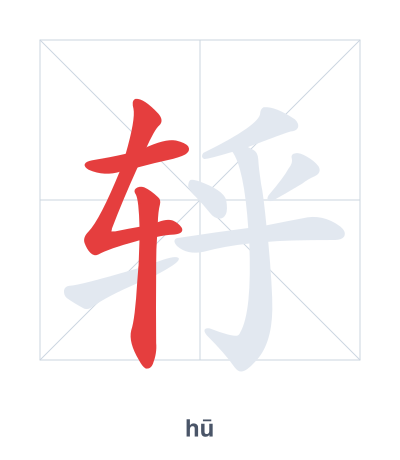
Open Hanzi Writer to see the animated stroke order and practice writing 轷 with real-time feedback.
The character 轷 (hū) is written with 9 strokes. Follow the standard Chinese stroke order: top to bottom, left to right, outside before inside. The radical 车 is one of its key components.
Practice the correct stroke order with the Hanzi Writer app to see animated stroke-by-stroke guidance with real-time feedback.
轷 means Hu (a surname or ancient carriage part).
轷 is a compound character formed by the radical 车 (carriage) and the phonetic component 乎 (hū). Originally, it referred to a part of an ancient carriage, such as a component of the axle or harness. Over time, it was also adopted as a surname, with the visual structure showing a carriage combined with the sound element 乎.
💡 Memory Tip: Picture a carriage (车) making a 'Hoo!' sound (乎) as it rattles along—hence the surname Hu.
轷是一个姓氏。
hū shì yí gè xìng shì
Hu is a surname.
这个字读作hū。
zhè ge zì dú zuò hū。
This character is pronounced 'hū'.
轷是古代车的一部分。
hū shì gǔ dài chē de yī bù fèn
Hu is a part of an ancient carriage.
Open Hanzi Writer to see the animated stroke order and practice writing 轷 with real-time feedback.
✨ Animated stroke order · Handwriting recognition · HSK-graded practice · Free to use
轷 is composed of the radical 车 (chē, meaning 'vehicle' or 'carriage') on the left, and the phonetic component 乎 (hū) on the right. The radical hints that the original meaning was related to carriages — specifically an ancient part of a carriage axle. Today, 轷 is mainly used as a surname, so the vehicle meaning is no longer common.