闳 (hóng) means "wide / vast / grand" in Chinese. It has 7 strokes with the radical 门.
Rated 3.5/5 in difficulty (challenging).
Appears in 3+ common words including 闳大 (hóng dà), 闳博 (hóng bó), 宽闳 (kuān hóng).
Due to its 7 strokes, Hanzi Writer's error detection shows 闳 requires focused practice — most learners need 10+ attempts for consistent accuracy.
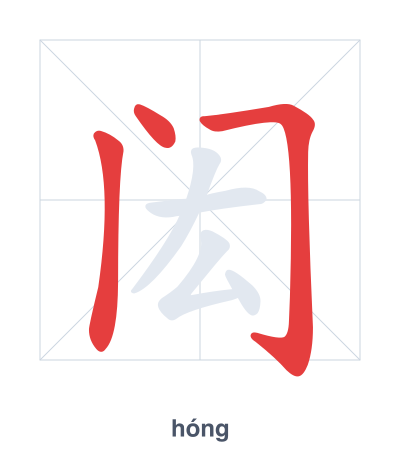
Open Hanzi Writer to see the animated stroke order and practice writing 闳 with real-time feedback.
The character 闳 (hóng) is written with 7 strokes. Follow the standard Chinese stroke order: top to bottom, left to right, outside before inside. The radical 门 is one of its key components.
Practice the correct stroke order with the Hanzi Writer app to see animated stroke-by-stroke guidance with real-time feedback.
闳 means wide / vast / grand.
闳 is a phono-semantic compound combining the radical 门 (gate), which conveys the idea of an opening or expanse, and 厷 (an ancient form of 肱 'upper arm') as a phonetic component. The meaning 'wide, vast, grand' derives from the image of a large gate or doorway that suggests breadth and magnitude.
💡 Memory Tip: Picture a grand gate (门) so wide that a giant arm (厷) stretches all the way across it, showing its vastness.
这个计划很闳大。
zhè ge jì huà hěn hóng dà
This plan is grand.
他的学问很闳博。
tā de xué wèn hěn hóng bó
His knowledge is extensive and profound.
他的心胸宽闳。
tā de xīn xiōng kuān hóng
He is broad-minded.
Open Hanzi Writer to see the animated stroke order and practice writing 闳 with real-time feedback.
✨ Animated stroke order · Handwriting recognition · HSK-graded practice · Free to use
The character 闳 is composed of the radical 门 (gate/door) on the outside and 弘 (hóng, meaning "great" or "enlarge") on the inside. The door radical suggests an entrance or gateway, while 弘 adds the idea of greatness, together creating the meaning of "wide" or "vast."