氦 (hài) means "Helium" in Chinese. It has 10 strokes with the radical 气.
Rated 4.2/5 in difficulty (advanced).
Appears in 3+ common words including 氦气 (hài qì), 氦气球 (hài qì qiú), 氦星 (hài xīng).
Due to its 10 strokes, Hanzi Writer's error detection shows 氦 requires focused practice — most learners need 10+ attempts for consistent accuracy.
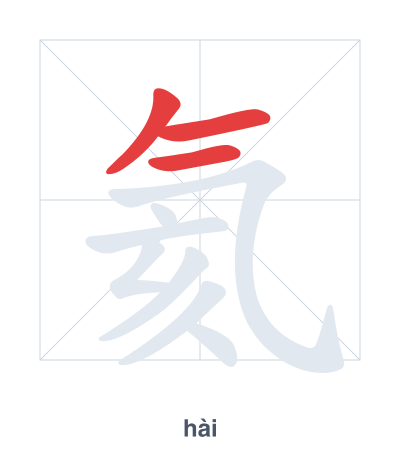
Open Hanzi Writer to see the animated stroke order and practice writing 氦 with real-time feedback.
The character 氦 (hài) is written with 10 strokes. Follow the standard Chinese stroke order: top to bottom, left to right, outside before inside. The radical 气 is one of its key components.
Practice the correct stroke order with the Hanzi Writer app to see animated stroke-by-stroke guidance with real-time feedback.
氦 means Helium.
| Character | 氦 |
| Pinyin | hài (hai) |
| Meaning | Helium |
| Strokes | 10 |
| Radical | 气 |
| Difficulty | 4.2/5 |
氦 is a compound character combining the radical 气 (gas/steam) as a semantic hint, and 亥 (hài) as a phonetic component indicating the pronunciation. It was created in modern times to represent the chemical element helium, a gaseous element.
💡 Memory Tip: Picture a pig (亥) inflated with helium gas (气) floating up into the sky like a balloon.
氦气可以充气球。
hài qì kě yǐ chōng qì qiú
Helium can be used to inflate balloons.
氦气球飞上了天。
hài qì qiú fēi shàng le tiān
The helium balloon flew up into the sky.
科学家发现了氦星。
kē xué jiā fā xiàn le hài xīng
Scientists discovered a helium star.
Open Hanzi Writer to see the animated stroke order and practice writing 氦 with real-time feedback.
✨ Animated stroke order · Handwriting recognition · HSK-graded practice · Free to use
氦 is made of the radical 气 (gas) on the left and the phonetic component 亥 (hài) on the right. The radical 气 signals that the character relates to gas, and 亥 provides the pronunciation. Together, they form the word for the gas helium.