妫 (guī) means "Gui (a surname or river name)" in Chinese. It has 7 strokes with the radical 女.
Rated 3.5/5 in difficulty (challenging).
Appears in 3+ common words including 妫水 (guī shuǐ), 妫姓 (guī xìng), 妫河 (guī hé).
Due to its 7 strokes, Hanzi Writer's error detection shows 妫 requires focused practice — most learners need 10+ attempts for consistent accuracy.
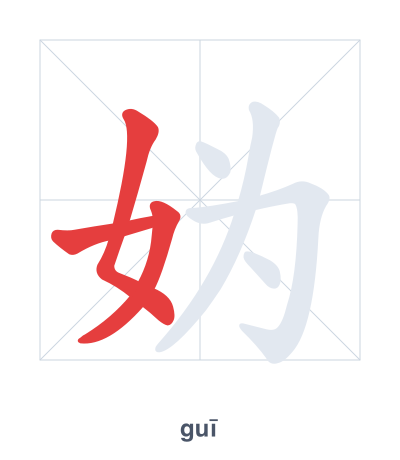
Open Hanzi Writer to see the animated stroke order and practice writing 妫 with real-time feedback.
The character 妫 (guī) is written with 7 strokes. Follow the standard Chinese stroke order: top to bottom, left to right, outside before inside. The radical 女 is one of its key components.
Practice the correct stroke order with the Hanzi Writer app to see animated stroke-by-stroke guidance with real-time feedback.
妫 means Gui (a surname or river name).
妫 is a compound character with the radical 女 (woman) and the phonetic component 为 (wéi). It was originally used to write the name of a river and later a surname in ancient China, with no direct semantic link to 'woman'—the 女 radical likely reflects a phonetic borrowing or early clan name.
💡 Memory Tip: Picture a woman (女) using a hook (the right side 为 resembles a hook) to fish in the Gui River.
妫水河就在北京。
guī shuǐ hé jiù zài běi jīng
The Guishui River is in Beijing.
妫是一个古老的姓氏。
guī shì yí gè gǔ lǎo de xìng shì
Gui is an ancient surname.
妫河的风景很美。
guī hé de fēng jǐng hěn měi
The scenery of the Gui River is very beautiful.
Open Hanzi Writer to see the animated stroke order and practice writing 妫 with real-time feedback.
✨ Animated stroke order · Handwriting recognition · HSK-graded practice · Free to use
The character 妫 is made of the radical 女 (woman) on the left and 为 (to do) on the right. However, the meaning of 妫 is not directly related to woman or doing — it is primarily used as a surname or the name of a river in ancient China. The radical 女 suggests it may have originally been a clan name associated with a female ancestor.