轱 (gū) means "Wheel (often used in compounds)" in Chinese. It has 9 strokes with the radical 车.
Rated 4/5 in difficulty (challenging).
Appears in 3+ common words including 轱辘 (gū lù), 轱辘话 (gū lù huà), 轱辘子 (gū lù zi).
Due to its 9 strokes, Hanzi Writer's error detection shows 轱 requires focused practice — most learners need 10+ attempts for consistent accuracy.
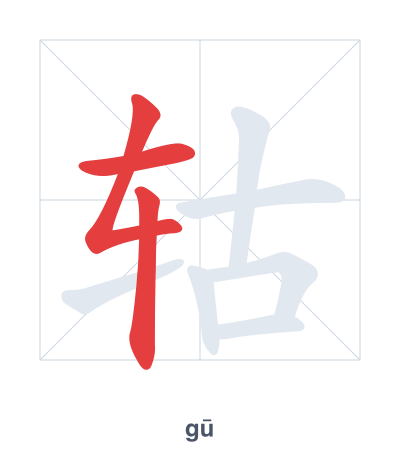
Open Hanzi Writer to see the animated stroke order and practice writing 轱 with real-time feedback.
The character 轱 (gū) is written with 9 strokes. Follow the standard Chinese stroke order: top to bottom, left to right, outside before inside. The radical 车 is one of its key components.
Practice the correct stroke order with the Hanzi Writer app to see animated stroke-by-stroke guidance with real-time feedback.
轱 means Wheel (often used in compounds).
The character 轱 is a compound with the radical 车 (vehicle/wheel) on the left, indicating its meaning related to wheels. The right component 古 (gǔ, 'ancient') serves as a phonetic hint, though the tone shifts to gū. Together, 轱 appears in words like 轱辘 (gūlu), which describes a wheel or roller, evoking the image of an old-fashioned cart wheel.
💡 Memory Tip: Picture an ancient (古) wheel (车) rolling noisily along a cobblestone road—that's 轱.
车轱辘在转。
chē gū lù zài zhuǎn
The wheels are turning.
别总说轱辘话。
bié zǒng shuō gū lù huà
Don't keep repeating the same things over and over.
这是一个木轱辘子。
zhè shì yí gè mù gū lù zi
This is a wooden wheel.
Open Hanzi Writer to see the animated stroke order and practice writing 轱 with real-time feedback.
✨ Animated stroke order · Handwriting recognition · HSK-graded practice · Free to use
轱 is made of the radical 车 (vehicle) on the left and 古 (ancient) on the right. The 车 radical gives the meaning of wheel or vehicle, while 古 provides a phonetic clue for the pronunciation gū.