黻 (fú) means "Embroidered pattern on ancient robes" in Chinese. It has 17 strokes with the radical 黹.
Rated 4.2/5 in difficulty (advanced).
Appears in 3+ common words including 黼黻 (fǔ fú), 黻绣 (fú xiù), 黻冕 (fú miǎn).
Due to its 17 strokes, Hanzi Writer's error detection shows 黻 requires focused practice — most learners need 10+ attempts for consistent accuracy.
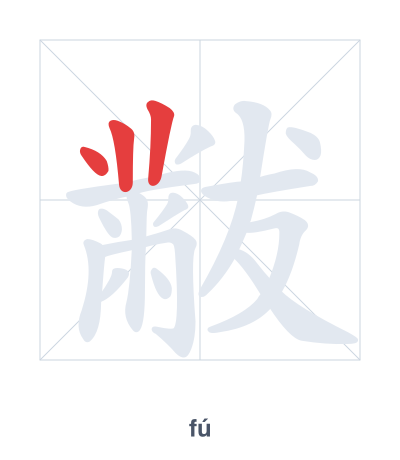
Open Hanzi Writer to see the animated stroke order and practice writing 黻 with real-time feedback.
The character 黻 (fú) is written with 17 strokes. Follow the standard Chinese stroke order: top to bottom, left to right, outside before inside. The radical 黹 is one of its key components.
Practice the correct stroke order with the Hanzi Writer app to see animated stroke-by-stroke guidance with real-time feedback.
黻 means Embroidered pattern on ancient robes.
| Character | 黻 |
| Pinyin | fú (fu) |
| Meaning | Embroidered pattern on ancient robes |
| Strokes | 17 |
| Radical | 黹 |
| Difficulty | 4.2/5 |
黻 is a compound character with the radical 黹 (embroidery) on the left and 犮 (bá, possibly phonetic) on the right. The character originally depicted a specific black-and-white zigzag pattern on ancient ceremonial robes, often described as two '己' shapes facing each other. The 黹 component signifies fabric and needlework, while 犮 may hint at the pattern's intertwined or 'running' design.
💡 Memory Tip: Picture an embroidered robe (黹) with a wild dog (犮) jumping through the zigzag pattern, its fur creating the black-and-white stripes.
衣服上有黼黻图案。
yī fú shàng yǒu fǔ fú tú àn
There are ancient ceremonial patterns on the clothes.
这种黻绣很特别。
zhè zhǒng fú xiù hěn tè bié
This kind of ancient embroidery is very special.
他穿着古老的黻冕。
tā chuān zhe gǔ lǎo de fú miǎn
He is wearing an ancient ceremonial crown and robe.
Open Hanzi Writer to see the animated stroke order and practice writing 黻 with real-time feedback.
✨ Animated stroke order · Handwriting recognition · HSK-graded practice · Free to use
黻 is composed of the radical 黹 on the left, which represents embroidery or needlework, and the component 犮 on the right, which gives the character its pronunciation fú. Together, the left part directly conveys the meaning of an embroidered pattern on ancient robes.