黼 (fǔ) means "Axe-shaped pattern on ancient robes" in Chinese. It has 19 strokes with the radical 黹.
Rated 4.2/5 in difficulty (advanced).
Appears in 3+ common words including 黼黻 (fǔ fú), 黼座 (fǔ zuò), 黼绣 (fǔ xiù).
Due to its 19 strokes, Hanzi Writer's error detection shows 黼 requires focused practice — most learners need 10+ attempts for consistent accuracy.
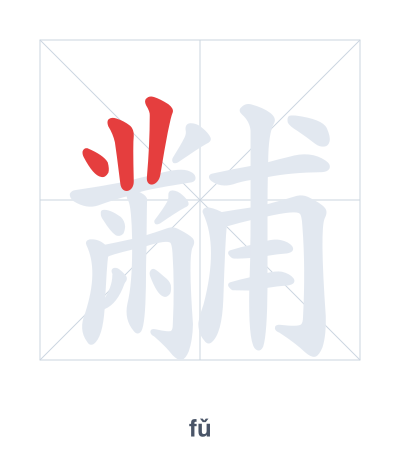
Open Hanzi Writer to see the animated stroke order and practice writing 黼 with real-time feedback.
The character 黼 (fǔ) is written with 19 strokes. Follow the standard Chinese stroke order: top to bottom, left to right, outside before inside. The radical 黹 is one of its key components.
Practice the correct stroke order with the Hanzi Writer app to see animated stroke-by-stroke guidance with real-time feedback.
黼 means Axe-shaped pattern on ancient robes.
| Character | 黼 |
| Pinyin | fǔ (fu) |
| Meaning | Axe-shaped pattern on ancient robes |
| Strokes | 19 |
| Radical | 黹 |
| Difficulty | 4.2/5 |
黼 is a compound character, combining the radical 黹 (embroidery, needlework) with the phonetic component 甫 (fǔ, meaning 'begin' but here provides sound). Together, 黹 indicates the embroidered pattern on silk, while the axe-like shape comes from the ancient ceremonial meaning, as the character originally described the white-and-black axe motif embroidered on official robes.
💡 Memory Tip: Imagine a royal robe covered in intricate embroidery (黹) that has a huge, shiny axe (think of 甫 as a handle with a blade) stitched right on the chest—this is the 黼 pattern of an ancient king.
这里的黼黻很精美。
zhè lǐ de fǔ fú hěn jīng měi
The ceremonial embroidery here is very exquisite.
他坐在黼座上。
tā zuò zài fǔ zuò shàng
He is sitting on the throne.
这种黼绣很少见。
zhè zhǒng fǔ xiù hěn shǎo jiàn
This kind of ancient axe-pattern embroidery is very rare.
Open Hanzi Writer to see the animated stroke order and practice writing 黼 with real-time feedback.
✨ Animated stroke order · Handwriting recognition · HSK-graded practice · Free to use
The left side is the radical 黹, which relates to embroidery and needlework. This shows the character is about decorative patterns on cloth. The right side 甫 gives the pronunciation fǔ and may connect to the shape of an axe, as the character's meaning is an axe-shaped pattern on ancient robes.