蘩 (fán) means "white mugwort" in Chinese. It has 20 strokes with the radical 艹.
Rated 4.2/5 in difficulty (advanced).
Appears in 3+ common words including 采蘩 (cǎi fán), 蘩芜 (fán wú), 蘩藻 (fán zǎo).
Due to its 20 strokes, Hanzi Writer's error detection shows 蘩 requires focused practice — most learners need 10+ attempts for consistent accuracy.
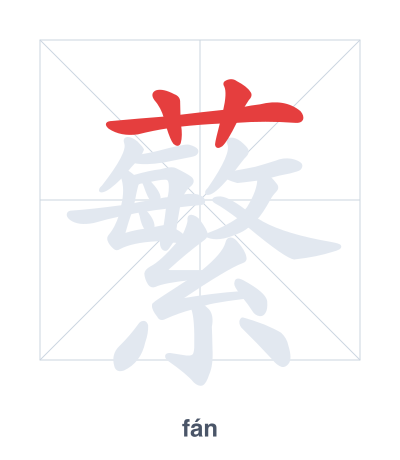
Open Hanzi Writer to see the animated stroke order and practice writing 蘩 with real-time feedback.
The character 蘩 (fán) is written with 20 strokes. Follow the standard Chinese stroke order: top to bottom, left to right, outside before inside. The radical 艹 is one of its key components.
Practice the correct stroke order with the Hanzi Writer app to see animated stroke-by-stroke guidance with real-time feedback.
蘩 means white mugwort.
蘩 is a phono-semantic compound: the grass radical 艹 indicates a plant, while 繁 (fán, meaning 'numerous' or 'dense') provides the sound and suggests the plant's abundant, clustered leaves and flowers. White mugwort (Artemisia lactiflora) is known for its dense growth of many small white flower heads.
💡 Memory Tip: Picture white mugwort (蘩) growing so thickly that its many grass-like stems (艹) form a tangled, dense mess (繁) covering the ground.
她们在河边采蘩。
tā men zài hé biān cǎi fán
They are picking white mugwort by the river.
这里的蘩芜很多。
zhè lǐ de fán wú hěn duō
There are many lush weeds here.
水中有很多蘩藻。
shuǐ zhōng yǒu hěn duō fán zǎo
There are many waterweeds in the water.
Open Hanzi Writer to see the animated stroke order and practice writing 蘩 with real-time feedback.
✨ Animated stroke order · Handwriting recognition · HSK-graded practice · Free to use
The character 蘩 is composed of the grass radical 艹 on top and the component 繁 below. The radical indicates it is a plant, while 繁 means "numerous" or "abundant," together describing white mugwort that grows in thick clusters.