轭 (è) means "Yoke" in Chinese. It has 8 strokes with the radical 车.
Rated 3.7/5 in difficulty (challenging).
Appears in 3+ common words including 轭头 (è tóu), 负轭 (fù è), 轭具 (è jù).
Due to its 8 strokes, Hanzi Writer's error detection shows 轭 requires focused practice — most learners need 10+ attempts for consistent accuracy.
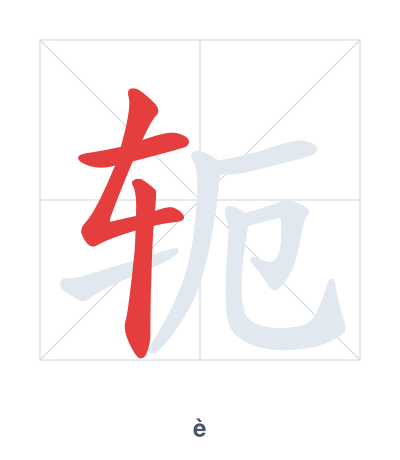
Open Hanzi Writer to see the animated stroke order and practice writing 轭 with real-time feedback.
The character 轭 (è) is written with 8 strokes. Follow the standard Chinese stroke order: top to bottom, left to right, outside before inside. The radical 车 is one of its key components.
Practice the correct stroke order with the Hanzi Writer app to see animated stroke-by-stroke guidance with real-time feedback.
轭 means Yoke.
轭 is a phono-semantic compound: the radical 车 (vehicle) indicates it relates to carts, while the phonetic component 厄 (è) hints at the pronunciation and also suggests the idea of constraint. Together, they depict the yoke, a wooden crosspiece that harnesses oxen to a cart, often causing strain.
💡 Memory Tip: Picture a cart (车) with a yoke shaped like a tight 'E' (厄) that pinches the ox's neck, causing distress.
轭头在牛的脖子上。
è tóu zài niú de bó zi shàng
The yoke is on the ox's neck.
牛在田里负轭拉车。
niú zài tián lǐ fù è lā chē
The ox is pulling a cart with a yoke in the field.
这是一套旧轭具。
zhè shì yī tào jiù è jù
This is a set of old yokes.
Open Hanzi Writer to see the animated stroke order and practice writing 轭 with real-time feedback.
✨ Animated stroke order · Handwriting recognition · HSK-graded practice · Free to use
The left component 车 means 'vehicle' or 'cart', showing that a yoke is used with carts or oxen. The right component 厄 originally depicted a yoke's shape, and together they form the meaning of a yoke that goes on an animal's neck to pull a load.