芏 (dù) means "Sedge" in Chinese. It has 6 strokes with the radical 艹.
Rated 3.2/5 in difficulty (challenging).
Appears in 3+ common words including 茳芏 (jiāng dù), 芏草 (dù cǎo), 芏席 (dù xí).
Due to its 6 strokes, Hanzi Writer's error detection shows 芏 requires focused practice — most learners need 10+ attempts for consistent accuracy.
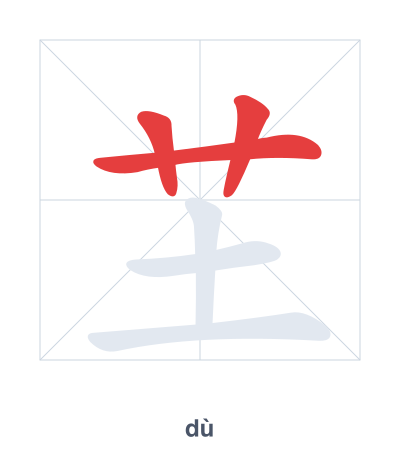
Open Hanzi Writer to see the animated stroke order and practice writing 芏 with real-time feedback.
The character 芏 (dù) is written with 6 strokes. Follow the standard Chinese stroke order: top to bottom, left to right, outside before inside. The radical 艹 is one of its key components.
Practice the correct stroke order with the Hanzi Writer app to see animated stroke-by-stroke guidance with real-time feedback.
芏 means Sedge.
The character 芏 combines the radical 艹 (grass) above 土 (earth), indicating a type of grass that grows in soil. It is a phono-semantic compound where 土 hints at the plant's habitat (damp earth) and also contributes to the pronunciation (dù). Sedge typically thrives in wet, earthy areas near marshes or rivers.
💡 Memory Tip: Picture a tall blade of grass (艹) sprouting from a mound of dirt (土)—that's the sedge plant rooting in the earth.
茳芏长在水边。
jiāng dù zhǎng zài shuǐ biān
Shichito matgrass grows by the water.
这是芏草。
zhè shì dù cǎo
This is a type of sedge.
他买了芏席。
tā mǎi le dù xí
He bought a sedge mat.
Open Hanzi Writer to see the animated stroke order and practice writing 芏 with real-time feedback.
✨ Animated stroke order · Handwriting recognition · HSK-graded practice · Free to use
芏 is composed of the radical 艹 (grass radical) on top and 土 (tǔ, meaning earth or soil) below. The grass radical suggests it is a type of plant, while the earth component indicates it grows in soil or muddy ground. Together, they form the meaning "sedge," a grass-like plant commonly found near wetlands.