牒 (dié) means "Official document / Dispatch" in Chinese. It has 13 strokes with the radical 片.
Rated 4.2/5 in difficulty (advanced).
Appears in 3+ common words including 通牒 (tōng dié), 牒文 (dié wén), 牒报 (dié bào).
Due to its 13 strokes, Hanzi Writer's error detection shows 牒 requires focused practice — most learners need 10+ attempts for consistent accuracy.
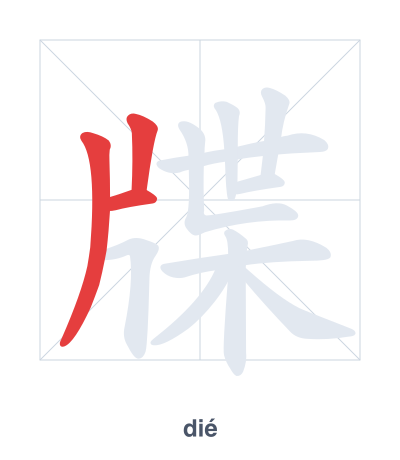
Open Hanzi Writer to see the animated stroke order and practice writing 牒 with real-time feedback.
The character 牒 (dié) is written with 13 strokes. Follow the standard Chinese stroke order: top to bottom, left to right, outside before inside. The radical 片 is one of its key components.
Practice the correct stroke order with the Hanzi Writer app to see animated stroke-by-stroke guidance with real-time feedback.
牒 means Official document / Dispatch.
| Character | 牒 |
| Pinyin | dié (die) |
| Meaning | Official document / Dispatch |
| Strokes | 13 |
| Radical | 片 |
| Difficulty | 4.2/5 |
The character 牒 combines the radical 片 (a wooden tablet or slice) with 枼 (yè, meaning a thin piece or leaf), forming a pictophonetic compound. In ancient China, official documents were written on thin wooden slips, so 牒 came to mean 'official document' or 'dispatch'.
💡 Memory Tip: Imagine a thin wooden slice (片) shaped like a leaf (枼) that carries an official government message.
他收到了通牒。
tā shōu dào le tōng dié
He received an ultimatum.
这是一份牒文。
zhè shì yī fèn dié wén
This is an official dispatch.
牒报传到了这里。
dié bào chuán dào le zhè lǐ
The dispatch has reached here.
Open Hanzi Writer to see the animated stroke order and practice writing 牒 with real-time feedback.
✨ Animated stroke order · Handwriting recognition · HSK-graded practice · Free to use
牒 has the radical 片 on the left, meaning "slice of wood" or "tablet." The right part is 枼, which gives a hint for the pronunciation dié. This structure reflects ancient wooden slips used for official records.