佃 (diàn) means "to rent land; tenant farming" in Chinese. It has 7 strokes with the radical 亻.
Rated 3.2/5 in difficulty (challenging).
Appears in 3+ common words including 佃农 (diàn nóng), 佃户 (diàn hù), 租佃 (zū diàn).
Due to its 7 strokes, Hanzi Writer's error detection shows 佃 requires focused practice — most learners need 10+ attempts for consistent accuracy.
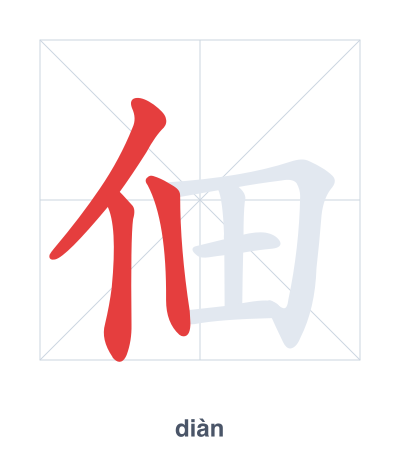
Open Hanzi Writer to see the animated stroke order and practice writing 佃 with real-time feedback.
The character 佃 (diàn) is written with 7 strokes. Follow the standard Chinese stroke order: top to bottom, left to right, outside before inside. The radical 亻 is one of its key components.
Practice the correct stroke order with the Hanzi Writer app to see animated stroke-by-stroke guidance with real-time feedback.
佃 means to rent land; tenant farming.
佃 combines a person (亻) with a field (田), originally depicting a farmer who works land that belongs to someone else. The character specifically refers to a tenant farmer who rents and cultivates land rather than owning it.
💡 Memory Tip: Picture a person (亻) standing in the middle of a rented field (田), counting coins to pay the landlord.
他以前是佃农。
tā yǐ qián shì diàn nóng
He used to be a tenant farmer.
佃户在种地。
diàn hù zài zhòng dì
The tenant farmer is working the land.
租佃关系很复杂。
zū diàn guān xì hěn fù zá
The tenancy relationship is very complex.
Open Hanzi Writer to see the animated stroke order and practice writing 佃 with real-time feedback.
✨ Animated stroke order · Handwriting recognition · HSK-graded practice · Free to use
佃 is made of the radical 亻 (person) on the left and 田 (field) on the right. The combination means "a person working in a field" — specifically someone who rents land to farm rather than owning it.