Hanzi Writer

How to Write 锉 (cuò) — Meaning “File (tool); to file”

cuò 12 strokes Radical: 钅

锉 (cuò) means "File (tool); to file" in Chinese. It has 12 strokes with the radical 钅.

Rated 4.2/5 in difficulty (advanced).

Appears in 3+ common words including 锉刀 (cuò dāo), 锉平 (cuò píng), 指甲锉 (zhǐ jiǎ cuò).

Due to its 12 strokes, Hanzi Writer's error detection shows 锉 requires focused practice — most learners need 10+ attempts for consistent accuracy.
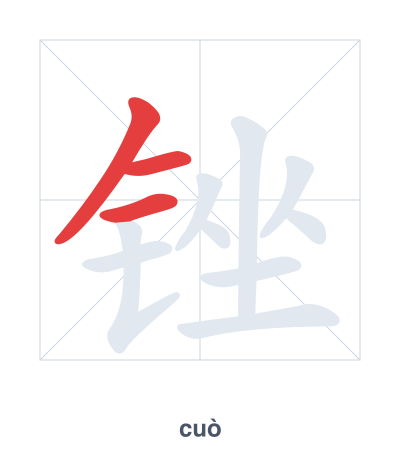
Stroke order practice for 锉 - cuò

Practice Writing 锉 (cuò)

Open Hanzi Writer to see the animated stroke order and practice writing 锉 with real-time feedback.

The character (cuò) is written with 12 strokes. Follow the standard Chinese stroke order: top to bottom, left to right, outside before inside. The radical is one of its key components.

Practice the correct stroke order with the Hanzi Writer app to see animated stroke-by-stroke guidance with real-time feedback.

means File (tool); to file.

Character
Pinyincuò (cuo)
MeaningFile (tool); to file
Strokes12
Radical
Difficulty4.2/5

锉 is a compound character combining the metal radical 钅 with 坐 (cuò), which provides the phonetic component. The metal radical indicates the tool is made of metal, while 坐 (to sit) hints at the file's function of being steadily pressed against a surface to smooth it.

💡 Memory Tip: Two people sit (坐) on a metal file (钅) to flatten a rough surface.

cuò dāo
File (tool)
cuò píng
To file down; to smooth with a file
zhǐ jiǎ cuò
nail file

他用锉刀打磨木头。

tā yòng cuò dāo dǎ mó mù tou

He used a file to sand the wood.

请把这个边角锉平。

qǐng bǎ zhè ge biān jiǎo cuò píng

Please file down this edge.

她正在用指甲锉修指甲。

tā zhèng zài yòng zhǐ jiǎ cuò xiū zhǐ jiǎ

She is filing her nails with a nail file.

Character Pinyin Strokes Radical
(current) cuò 12
10
qián 10
zhēng 10
Stroke order practice for 锉 - cuò

Practice Writing 锉 (cuò)

Open Hanzi Writer to see the animated stroke order and practice writing 锉 with real-time feedback.

✨ Animated stroke order · Handwriting recognition · HSK-graded practice · Free to use

Frequently Asked Questions about 锉

锉 is made of the radical 钅 (metal) on the left, and the phonetic component 坐 (zuò, meaning 'to sit') on the right. The metal radical indicates that a file is a metal tool. The right part suggests the sound cuò but also hints at the action of pressing down while filing.

Characters with Radical 钅

Other 12-Stroke Characters