砗 (chē) means "Giant clam (used in 砗磲)" in Chinese. It has 9 strokes with the radical 石.
Rated 4/5 in difficulty (challenging).
Appears in 3+ common words including 砗磲 (chē qú), 砗磲贝 (chē qú bèi), 砗磲珠 (chē qú zhū).
Due to its 9 strokes, Hanzi Writer's error detection shows 砗 requires focused practice — most learners need 10+ attempts for consistent accuracy.
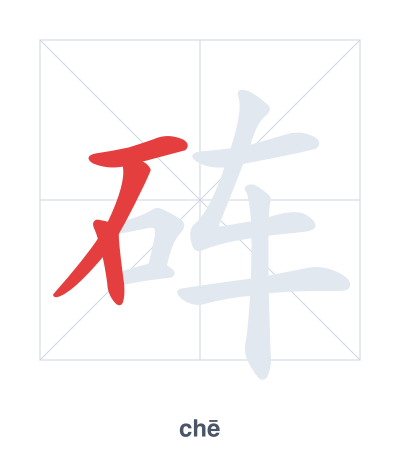
Open Hanzi Writer to see the animated stroke order and practice writing 砗 with real-time feedback.
The character 砗 (chē) is written with 9 strokes. Follow the standard Chinese stroke order: top to bottom, left to right, outside before inside. The radical 石 is one of its key components.
Practice the correct stroke order with the Hanzi Writer app to see animated stroke-by-stroke guidance with real-time feedback.
砗 means Giant clam (used in 砗磲).
This character is a phono-semantic compound formed with the radical 石 (stone), indicating that giant clam shells are hard like stone, and the phonetic component 车 (chē) which provides the pronunciation.
💡 Memory Tip: Picture a giant clam (砗) as a stone (石) that is so massive it can carry a car (车) on its shell.
砗磲是一种海洋生物。
chē qú shì yī zhǒng hǎi yáng shēng wù
The giant clam is a marine organism.
砗磲贝的壳很大。
chē qú bèi de ké hěn dà
The shell of the giant clam is very large.
她戴着一串砗磲珠。
tā dài zhe yī chuàn chē qú zhū
She is wearing a string of giant clam beads.
Open Hanzi Writer to see the animated stroke order and practice writing 砗 with real-time feedback.
✨ Animated stroke order · Handwriting recognition · HSK-graded practice · Free to use
砗 is formed from the radical 石 (stone) on the left and 车 (vehicle/car) on the right. The stone radical indicates that this character relates to a hard, stone-like object, which fits the giant clam's thick shell. The right side 车 mainly provides pronunciation (chē) and does not directly contribute to the meaning.