忭 (biàn) means "delighted; pleased" in Chinese. It has 7 strokes with the radical 忄.
Rated 3.5/5 in difficulty (challenging).
Appears in 3+ common words including 欢忭 (huān biàn), 欣忭 (xīn biàn), 忭跃 (biàn yuè).
Due to its 7 strokes, Hanzi Writer's error detection shows 忭 requires focused practice — most learners need 10+ attempts for consistent accuracy.
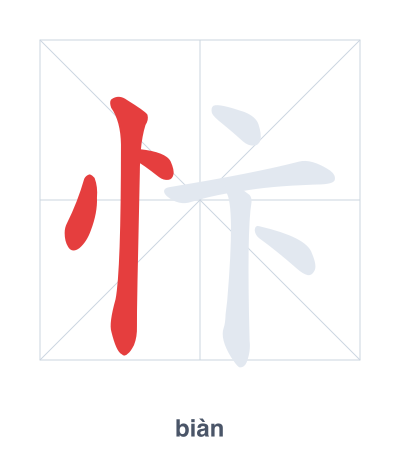
Open Hanzi Writer to see the animated stroke order and practice writing 忭 with real-time feedback.
The character 忭 (biàn) is written with 7 strokes. Follow the standard Chinese stroke order: top to bottom, left to right, outside before inside. The radical 忄 is one of its key components.
Practice the correct stroke order with the Hanzi Writer app to see animated stroke-by-stroke guidance with real-time feedback.
忭 means delighted; pleased.
忭 is a phono-semantic compound: the radical 忄 (heart, emotion of joy) combines with 卞 (biàn), which gives the sound, to form the character meaning 'delighted' or 'pleased'—a feeling bursting from the heart.
💡 Memory Tip: Imagine a heart (忄) is so delighted that it springs up like a bouncing ball, and the bouncing ball lands on a lid (卞) with a cheerful pop.
大家欢忭鼓舞。
dà jiā huān biàn gǔ wǔ
Everyone was jubilant and encouraged.
闻讯后他十分欣忭。
wén xùn hòu tā shí fēn xīn biàn
He was very joyful after hearing the news.
这消息令人欢欣忭跃。
zhè xiāo xī lìng rén huān xīn biàn yuè
This news makes people jump for joy.
Open Hanzi Writer to see the animated stroke order and practice writing 忭 with real-time feedback.
✨ Animated stroke order · Handwriting recognition · HSK-graded practice · Free to use
The character 忭 is composed of the radical 忄 (heart) on the left and 卞 (biàn) on the right. The heart radical suggests emotion, while 卞 provides the pronunciation. Together they show a feeling of delight coming from the heart.