阼 (zuò) means "steps on the east side of a hall" in Chinese. It has 7 strokes with the radical 阝.
Rated 3.2/5 in difficulty (challenging).
Appears in 3+ common words including 阼阶 (zuò jiē), 践阼 (jiàn zuò), 阼席 (zuò xí).
Due to its 7 strokes, Hanzi Writer's error detection shows 阼 requires focused practice — most learners need 10+ attempts for consistent accuracy.
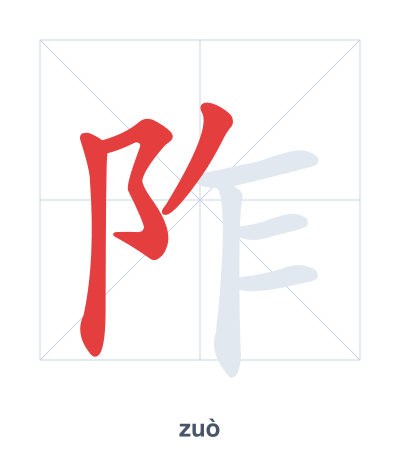
Open Hanzi Writer to see the animated stroke order and practice writing 阼 with real-time feedback.
The character 阼 (zuò) is written with 7 strokes. Follow the standard Chinese stroke order: top to bottom, left to right, outside before inside. The radical 阝 is one of its key components.
Practice the correct stroke order with the Hanzi Writer app to see animated stroke-by-stroke guidance with real-time feedback.
阼 means steps on the east side of a hall.
The character 阼 combines the radical 阝 (a form of 阜, meaning a mound or staircase) on the left with the phonetic component 乍 (zhà, 'suddenly') on the right. The left side indicates its meaning related to steps or stairs, originally depicting a set of ascending platforms. Specifically, 阼 refers to the eastern steps of a hall, used by the host in ancient Chinese ceremonies.
💡 Memory Tip: Imagine the host suddenly (乍) tripping on the eastern steps (阝) of the hall in front of all the guests.
他走上了阼阶。
tā zǒu shàng le zuò jiē
He walked up the eastern steps.
新王准备践阼。
xīn wáng zhǔn bèi jiàn zuò
The new king is preparing to ascend the throne.
宾客坐在阼席。
bīn kè zuò zài zuò xí
The guests sat in the honored seats.
Open Hanzi Writer to see the animated stroke order and practice writing 阼 with real-time feedback.
✨ Animated stroke order · Handwriting recognition · HSK-graded practice · Free to use
阼 is made of two parts: the left radical 阝, which means a mound or hill, and the right part 乍. Together they suggest a raised platform or steps, specifically the eastern steps of a hall. The 阝 hints at an architectural structure, while 乍 provides the sound and completes the character.