砧 (zhēn) means "Chopping block / Anvil" in Chinese. It has 10 strokes with the radical 石.
Rated 4.2/5 in difficulty (advanced).
Appears in 3+ common words including 砧板 (zhēn bǎn), 砧木 (zhēn mù), 砧骨 (zhēn gǔ).
Due to its 10 strokes, Hanzi Writer's error detection shows 砧 requires focused practice — most learners need 10+ attempts for consistent accuracy.
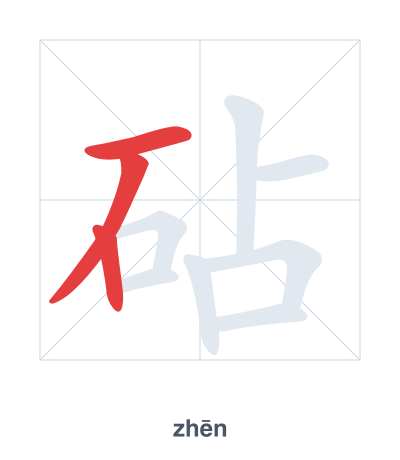
Open Hanzi Writer to see the animated stroke order and practice writing 砧 with real-time feedback.
The character 砧 (zhēn) is written with 10 strokes. Follow the standard Chinese stroke order: top to bottom, left to right, outside before inside. The radical 石 is one of its key components.
Practice the correct stroke order with the Hanzi Writer app to see animated stroke-by-stroke guidance with real-time feedback.
砧 means Chopping block / Anvil.
砧 is a compound character: the radical 石 (stone) indicates the material, while 占 (zhàn, 'to divine') hints at the pronunciation. Ancient chopping blocks and anvils were often made of stone, so the character visually combines a stone with the phonetic component to represent a solid surface for cutting or hammering.
💡 Memory Tip: Imagine a stone (石) anvil where a fortune teller (占) pounds meat with a cleaver, the 'divined' cuts revealing the future.
他在砧板上切菜。
tā zài zhēn bǎn shàng qiè cài
He is chopping vegetables on the cutting board.
这棵树需要砧木。
zhè kē shù xū yào zhēn mù
This tree needs a rootstock.
耳朵里有砧骨。
ěr duǒ lǐ yǒu zhēn gǔ
There is an incus (anvil bone) in the ear.
Open Hanzi Writer to see the animated stroke order and practice writing 砧 with real-time feedback.
✨ Animated stroke order · Handwriting recognition · HSK-graded practice · Free to use
砧 combines the radical 石 (stone) on the left and 占 on the right. The stone radical indicates a hard, flat surface, which matches the idea of a chopping block or anvil. The right part 占 provides the sound (zhēn) but does not directly contribute to meaning.