茚 (yìn) means "indene" in Chinese. It has 8 strokes with the radical 艹.
Rated 3.7/5 in difficulty (challenging).
Appears in 3+ common words including 茚满 (yìn mǎn), 茚三酮 (yìn sān tóng), 茚地那韦 (yìn dì nà wéi).
Due to its 8 strokes, Hanzi Writer's error detection shows 茚 requires focused practice — most learners need 10+ attempts for consistent accuracy.
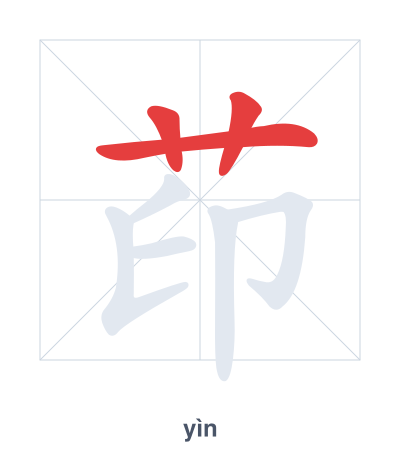
Open Hanzi Writer to see the animated stroke order and practice writing 茚 with real-time feedback.
The character 茚 (yìn) is written with 8 strokes. Follow the standard Chinese stroke order: top to bottom, left to right, outside before inside. The radical 艹 is one of its key components.
Practice the correct stroke order with the Hanzi Writer app to see animated stroke-by-stroke guidance with real-time feedback.
茚 means indene.
茚 is a modern phono-semantic compound where the radical 艹 (grass/plant) hints at an organic compound, and 印 (yìn, meaning 'seal' or 'stamp') supplies the pronunciation. Though indene is not a plant-derived substance, the 艹 radical is commonly used in Chinese chemical nomenclature for hydrocarbons.
💡 Memory Tip: Picture a plant (艹) with a stamp (印) that imprints the chemical formula of indene onto a leaf.
茚满是化学品。
yìn mǎn shì huà xué pǐn
Indane is a chemical.
实验需要茚三酮。
shí yàn xū yào yìn sān tóng
The experiment requires ninhydrin.
这是茚地那韦。
zhè shì yìn dì nà wéi
This is Indinavir.
Open Hanzi Writer to see the animated stroke order and practice writing 茚 with real-time feedback.
✨ Animated stroke order · Handwriting recognition · HSK-graded practice · Free to use
茚 is made of the radical 艹 (grass) on top and 印 (yìn, stamp) below. The grass radical is often used in chemical character names, while 印 gives the pronunciation. Together they form the term for indene, an organic compound.