邺 (yè) means "Ye (ancient place name)" in Chinese. It has 7 strokes with the radical 阝.
Rated 3.2/5 in difficulty (challenging).
Appears in 3+ common words including 邺城 (yè chéng), 邺都 (yè dōu), 姓邺 (xìng yè).
Due to its 7 strokes, Hanzi Writer's error detection shows 邺 requires focused practice — most learners need 10+ attempts for consistent accuracy.
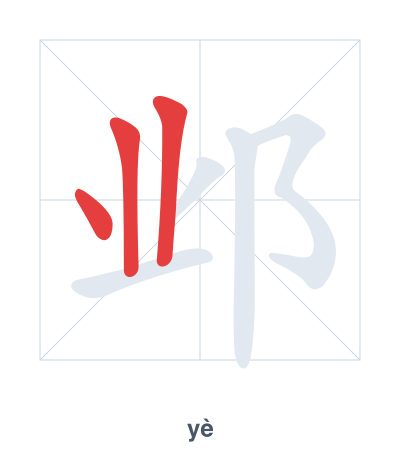
Open Hanzi Writer to see the animated stroke order and practice writing 邺 with real-time feedback.
The character 邺 (yè) is written with 7 strokes. Follow the standard Chinese stroke order: top to bottom, left to right, outside before inside. The radical 阝 is one of its key components.
Practice the correct stroke order with the Hanzi Writer app to see animated stroke-by-stroke guidance with real-time feedback.
邺 means Ye (ancient place name).
邺 is a phono-semantic compound combining the radical 阝 (city/town) with 业 (yè), which provides the pronunciation. It refers to an ancient city in present-day Hebei province, historically significant as a capital during the Three Kingdoms period.
💡 Memory Tip: Picture a bustling city (阝) where every building is a busy factory (业) — that's ancient Ye.
邺城在河北省。
yè chéng zài hé běi shěng
Yecheng is in Hebei Province.
邺都是古代的都城。
yè dōu shì gǔ dài de dū chéng
Ye was an ancient capital city.
他的祖籍在邺城。
tā de zǔ jí zài yè chéng
His ancestral home is in Yecheng.
Open Hanzi Writer to see the animated stroke order and practice writing 邺 with real-time feedback.
✨ Animated stroke order · Handwriting recognition · HSK-graded practice · Free to use
The character 邺 is composed of the radical 阝 (left ear) on the left and 业 (yè) on the right. The 阝 radical is associated with cities or places, and 业 provides the pronunciation, so the whole character refers to an ancient place name Ye.