昕 (xīn) means "Dawn / Early morning" in Chinese. It has 8 strokes with the radical 日.
Rated 3.7/5 in difficulty (challenging).
Appears in 3+ common words including 昕夕 (xīn xī), 昕旦 (xīn dàn), 昕明 (xīn míng).
Due to its 8 strokes, Hanzi Writer's error detection shows 昕 requires focused practice — most learners need 10+ attempts for consistent accuracy.
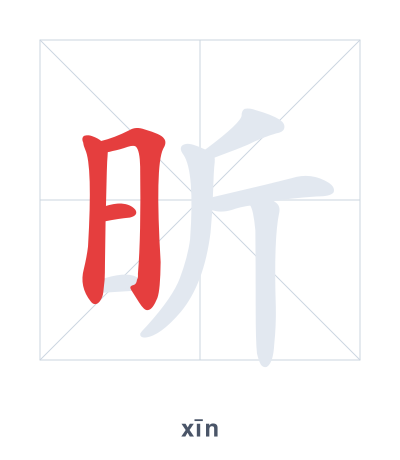
Open Hanzi Writer to see the animated stroke order and practice writing 昕 with real-time feedback.
The character 昕 (xīn) is written with 8 strokes. Follow the standard Chinese stroke order: top to bottom, left to right, outside before inside. The radical 日 is one of its key components.
Practice the correct stroke order with the Hanzi Writer app to see animated stroke-by-stroke guidance with real-time feedback.
昕 means Dawn / Early morning.
昕 is a phono-semantic compound (形声字). The radical 日 (sun) indicates that the meaning relates to daylight, while 斤 (jīn, an axe) provides the sound. Together they depict the moment when the sun appears, like an axe cutting through the darkness of night to reveal dawn.
💡 Memory Tip: Imagine the sun (日) swinging an axe (斤) to chop away the dark, bringing the first light of dawn.
他昕夕都在忙碌。
tā xīn xī dōu zài máng lù
He is busy from morning till night.
昕旦就是清晨。
xīn dàn jiù shì qīng chén
'Xindan' means early morning.
昕明时分天亮了。
xīn míng shí fēn tiān liàng le
It became light at dawn.
Open Hanzi Writer to see the animated stroke order and practice writing 昕 with real-time feedback.
✨ Animated stroke order · Handwriting recognition · HSK-graded practice · Free to use
昕 is made of two parts: the left side 日 (sun) and the right side 斤 (axe). The sun component suggests daylight or time of day, while 斤 acts as a phonetic hint for the pronunciation xīn. Together they form the idea of dawn—the moment the sun appears in the early morning.