苋 (xiàn) means "Amaranth" in Chinese. It has 7 strokes with the radical 艹.
Rated 3.5/5 in difficulty (challenging).
Appears in 3+ common words including 苋菜 (xiàn cài), 红苋菜 (hóng xiàn cài), 绿苋菜 (lǜ xiàn cài).
Due to its 7 strokes, Hanzi Writer's error detection shows 苋 requires focused practice — most learners need 10+ attempts for consistent accuracy.
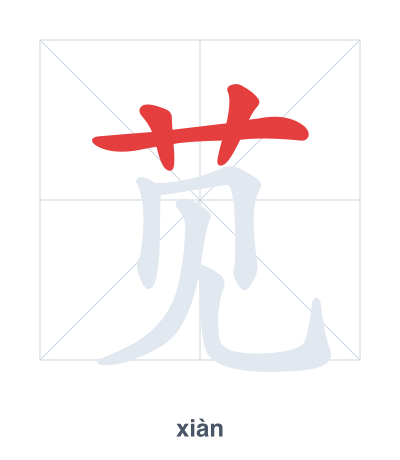
Open Hanzi Writer to see the animated stroke order and practice writing 苋 with real-time feedback.
The character 苋 (xiàn) is written with 7 strokes. Follow the standard Chinese stroke order: top to bottom, left to right, outside before inside. The radical 艹 is one of its key components.
Practice the correct stroke order with the Hanzi Writer app to see animated stroke-by-stroke guidance with real-time feedback.
苋 means Amaranth.
苋 is a compound character: the radical 艹 (grass) indicates it's a plant, while 见 (see) serves as a phonetic component hinting at the sound xiàn. This structure classifies it as a semantic-phonetic compound, where the grass radical connects to amaranth, an edible leafy green.
💡 Memory Tip: Imagine a patch of amaranth (苋) so tall and colorful that you can easily see (见) its bright red leaves above the grass (艹).
苋菜很有营养。
xiàn cài hěn yǒu yíng yǎng
Amaranth is very nutritious.
妈妈买了红苋菜。
mā mā mǎi le hóng xiàn cài
Mom bought red amaranth.
绿苋菜也很好吃。
lǜ xiàn cài yě hěn hǎo chī
Green amaranth is also delicious.
Open Hanzi Writer to see the animated stroke order and practice writing 苋 with real-time feedback.
✨ Animated stroke order · Handwriting recognition · HSK-graded practice · Free to use
苋 combines the radical 艹 (grass/plant) on top with 见 (jiàn, to see) below. The radical indicates it is a type of plant, while 见 originally meant "to appear" or "to be seen," possibly referencing the amaranth's showy, visible flowers. So the structure points to a conspicuous plant.