屃 (xì) means "gigantic tortoise (mythology)" in Chinese. It has 7 strokes with the radical 尸.
Rated 3.5/5 in difficulty (challenging).
Appears in 3+ common words including 赑屃 (bì xì), 屃屃 (xì xì), 碑屃 (bēi xì).
Due to its 7 strokes, Hanzi Writer's error detection shows 屃 requires focused practice — most learners need 10+ attempts for consistent accuracy.
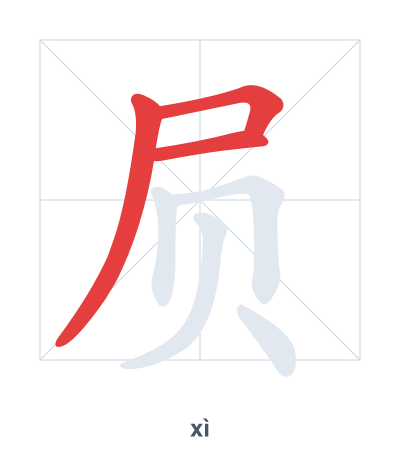
Open Hanzi Writer to see the animated stroke order and practice writing 屃 with real-time feedback.
The character 屃 (xì) is written with 7 strokes. Follow the standard Chinese stroke order: top to bottom, left to right, outside before inside. The radical 尸 is one of its key components.
Practice the correct stroke order with the Hanzi Writer app to see animated stroke-by-stroke guidance with real-time feedback.
屃 means gigantic tortoise (mythology).
屃 is a compound character: the radical 尸 (corpse or body) suggests a creature in a resting pose, while 贝 (shell) represents the tortoise’s hard carapace. Together they depict a mythical giant tortoise, often shown carrying a stone tablet on its back.
💡 Memory Tip: Picture a huge tortoise lying flat like a corpse (尸) but with a bright shell (贝) so massive it looks like a treasure island.
龙生九子有赑屃。
lóng shēng jiǔ zi yǒu bì xì
The dragon has nine sons, and Bixi is one of them.
这种力量很屃屃。
zhè zhǒng lì liàng hěn xì xì
This power is very mighty.
石碑下是碑屃。
shí bēi xià shì bēi xì
Under the stone tablet is a Bixi (mythological turtle).
Open Hanzi Writer to see the animated stroke order and practice writing 屃 with real-time feedback.
✨ Animated stroke order · Handwriting recognition · HSK-graded practice · Free to use
The character 屃 consists of the radical 尸 (corpse or body) on top and the component 贝 (shell) below. The radical 尸 may represent the animal's body, while 贝 hints at the turtle's hard shell. Together they visually suggest a turtle-like creature.