怃 (wǔ) means "disappointed; to comfort" in Chinese. It has 7 strokes with the radical 忄.
Rated 3.5/5 in difficulty (challenging).
Appears in 3+ common words including 怃然 (wǔ rán), 惊怃 (jīng wǔ), 怃恤 (wǔ xù).
Due to its 7 strokes, Hanzi Writer's error detection shows 怃 requires focused practice — most learners need 10+ attempts for consistent accuracy.
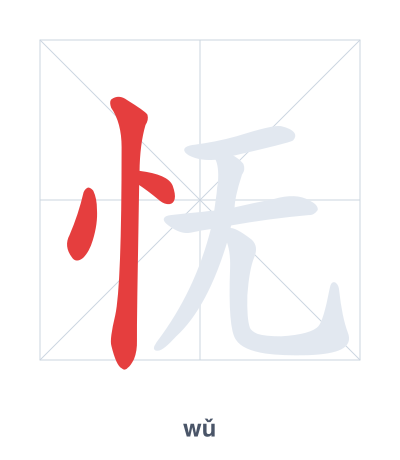
Open Hanzi Writer to see the animated stroke order and practice writing 怃 with real-time feedback.
The character 怃 (wǔ) is written with 7 strokes. Follow the standard Chinese stroke order: top to bottom, left to right, outside before inside. The radical 忄 is one of its key components.
Practice the correct stroke order with the Hanzi Writer app to see animated stroke-by-stroke guidance with real-time feedback.
怃 means disappointed; to comfort.
怃 combines the heart radical 忄 (xīn, mind/heart) with 无 (wú, without/nothing). The character suggests a heart feeling empty or lacking something, which conveys both the sense of disappointment (a hollow feeling) and the act of comforting (filling that emptiness).
💡 Memory Tip: Imagine your heart (忄) has nothing (无) inside, making you feel disappointed—so you give it a comforting hug.
他怃然长叹。
tā wǔ rán cháng tàn
He sighed in disappointment.
令人感到惊怃。
lìng rén gǎn dào jīng wǔ
It makes one feel startled and frustrated.
政府发放怃恤金。
zhèng fǔ fā fàng wǔ xù jīn
The government issues pensions.
Open Hanzi Writer to see the animated stroke order and practice writing 怃 with real-time feedback.
✨ Animated stroke order · Handwriting recognition · HSK-graded practice · Free to use
The character 怃 is made of the radical 忄 (heart) on the left and the component 无 (wǔ) on the right. Because 忄 relates to emotions, and 无 means 'without' or 'not have', the combination suggests a feeling of lacking something, which leads to meanings like 'disappointed' or 'to comfort' (to fill an emotional gap).