鷈 (tī) means "Grebe" in Chinese. It has 21 strokes with the radical 鳥.
Rated 3.8/5 in difficulty (challenging).
Appears in 3+ common words including 鷈鸟 (tī niǎo), 小鷈 (xiǎo tī), 鷈蛋 (tī dàn).
Due to its 21 strokes, Hanzi Writer's error detection shows 鷈 requires focused practice — most learners need 10+ attempts for consistent accuracy.
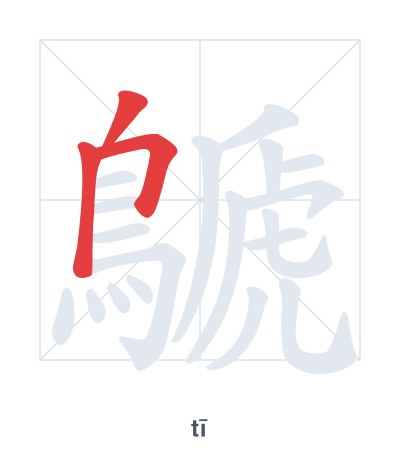
Open Hanzi Writer to see the animated stroke order and practice writing 鷈 with real-time feedback.
The character 鷈 (tī) is written with 21 strokes. Follow the standard Chinese stroke order: top to bottom, left to right, outside before inside. The radical 鳥 is one of its key components.
Practice the correct stroke order with the Hanzi Writer app to see animated stroke-by-stroke guidance with real-time feedback.
鷈 means Grebe.
| Character | 鷈 |
| Pinyin | tī (ti) |
| Meaning | Grebe |
| Strokes | 21 |
| Radical | 鳥 |
| Difficulty | 3.8/5 |
鷈 is a phono-semantic compound combining the radical 鳥 (bird) with 氐 (dǐ, the phonetic component). The character specifically names a grebe, a diving waterbird.
💡 Memory Tip: Picture the bird radical 鳥 diving low, with the left component 氐 looking like its body plunging headfirst into the water, just like a grebe does.
湖边有鷈鸟。
hú biān yǒu tī niǎo
There are grebes by the lake.
小鷈在水里。
xiǎo tī zài shuǐ lǐ
The little grebe is in the water.
这是鷈蛋。
zhè shì tī dàn
This is a grebe egg.
Open Hanzi Writer to see the animated stroke order and practice writing 鷈 with real-time feedback.
✨ Animated stroke order · Handwriting recognition · HSK-graded practice · Free to use
The character 鷈 is a left-right structure. The left side is the radical 鳥 (bird), which gives the meaning of a bird, and the right side is 弟 (dì, younger brother), which provides a pronunciation hint, though the actual pinyin is tī, not dì.