纴 (rèn) means "to weave; thread" in Chinese. It has 7 strokes with the radical 纟.
Rated 3.5/5 in difficulty (challenging).
Appears in 3+ common words including 纴织 (rèn zhī), 织纴 (zhī rèn), 纴线 (rèn xiàn).
Due to its 7 strokes, Hanzi Writer's error detection shows 纴 requires focused practice — most learners need 10+ attempts for consistent accuracy.
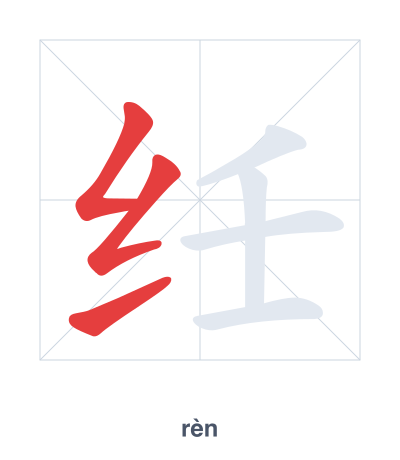
Open Hanzi Writer to see the animated stroke order and practice writing 纴 with real-time feedback.
The character 纴 (rèn) is written with 7 strokes. Follow the standard Chinese stroke order: top to bottom, left to right, outside before inside. The radical 纟 is one of its key components.
Practice the correct stroke order with the Hanzi Writer app to see animated stroke-by-stroke guidance with real-time feedback.
纴 means to weave; thread.
纴 combines the silk radical 纟 (thread/fabric) with 壬 (rén), which serves as a phonetic component. The silk radical directly connects to the meaning of weaving or thread, while 壬 adds the sound without contributing to the meaning.
💡 Memory Tip: Picture a person (壬) holding a spool of silk (纟) and threading it through a loom to weave cloth.
她在家里学习纴织。
tā zài jiā lǐ xué xí rèn zhī
She is learning weaving at home.
织纴是传统的手艺。
zhī rèn shì chuán tǒng de shǒu yì
Weaving and spinning is a traditional craft.
纴线需要很细心。
rèn xiàn xū yào hěn xì xīn
Threading a needle requires great care.
Open Hanzi Writer to see the animated stroke order and practice writing 纴 with real-time feedback.
✨ Animated stroke order · Handwriting recognition · HSK-graded practice · Free to use
纴 is composed of the radical 纟 (silk thread) on the left, which hints at thread or weaving, and the component 壬 (rén) on the right, which contributes the sound. Together, the silk radical and the phonetic part show that 纴 means 'to weave' or 'thread'.