佉 (qū) means "used in transliterations" in Chinese. It has 7 strokes with the radical 亻.
Rated 3.2/5 in difficulty (challenging).
Appears in 3+ common words including 佉沙 (qū shā), 佉卢 (qū lú), 佉楼 (qū lóu).
Due to its 7 strokes, Hanzi Writer's error detection shows 佉 requires focused practice — most learners need 10+ attempts for consistent accuracy.
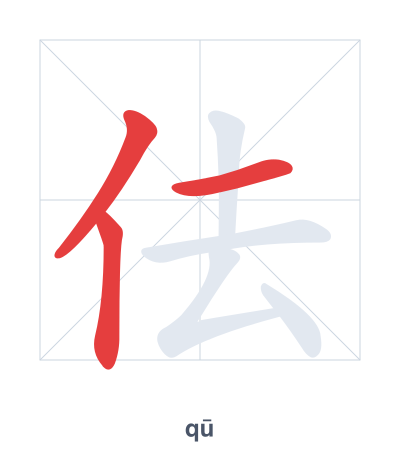
Open Hanzi Writer to see the animated stroke order and practice writing 佉 with real-time feedback.
The character 佉 (qū) is written with 7 strokes. Follow the standard Chinese stroke order: top to bottom, left to right, outside before inside. The radical 亻 is one of its key components.
Practice the correct stroke order with the Hanzi Writer app to see animated stroke-by-stroke guidance with real-time feedback.
佉 means used in transliterations.
佉 is a compound character formed from the radical 亻 (person) and the phonetic component 去 (qù, meaning 'to go'). The radical suggests a person, but the character's primary function is phonetic, used to transcribe foreign sounds such as 'kha' in early Chinese translations of Buddhist texts. Its structural role as a loan character for transliteration is its key feature.
💡 Memory Tip: Picture a person (亻) going (去) to a foreign country, where they have to borrow a funny sound like 'kha' for their name—that's 佉, the transliteration helper.
佉沙是一个古地名。
qū shā shì yí gè gǔ dì míng
Kashgar is an ancient place name.
这种文字叫佉卢文。
zhè zhǒng wén zì jiào qū lú wén
This script is called Kharosthi.
佉楼是古代的文字。
qū lóu shì gǔ dài de wén zì
Kharosthi is an ancient script.
Open Hanzi Writer to see the animated stroke order and practice writing 佉 with real-time feedback.
✨ Animated stroke order · Handwriting recognition · HSK-graded practice · Free to use
佉 is composed of the radical 亻 (person, left side) and 去 (qù, meaning 'go' or 'leave', right side). The person radical suggests a human-related concept, but in this case the character is not used for a native Chinese word; instead it functions purely as a phonetic component for transliterating foreign sounds. The right part 去 provides the approximate pronunciation qū.