泅 (qiú) means "To swim" in Chinese. It has 8 strokes with the radical 氵.
Rated 3.7/5 in difficulty (challenging).
Appears in 3+ common words including 泅水 (qiú shuǐ), 泅渡 (qiú dù), 泅泳 (qiú yǒng).
Due to its 8 strokes, Hanzi Writer's error detection shows 泅 requires focused practice — most learners need 10+ attempts for consistent accuracy.
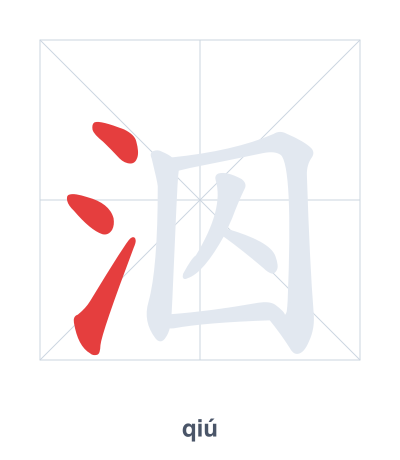
Open Hanzi Writer to see the animated stroke order and practice writing 泅 with real-time feedback.
The character 泅 (qiú) is written with 8 strokes. Follow the standard Chinese stroke order: top to bottom, left to right, outside before inside. The radical 氵 is one of its key components.
Practice the correct stroke order with the Hanzi Writer app to see animated stroke-by-stroke guidance with real-time feedback.
泅 means To swim.
泅 combines the water radical 氵 with 囚 (qiú, meaning 'prisoner'), which also gives the character its pronunciation. The image suggests a prisoner immersed in water, evoking the idea of swimming while confined or struggling to stay afloat.
💡 Memory Tip: Picture a prisoner (囚) swimming frantically in water (氵) to break free.
他在河里泅水。
tā zài hé lǐ qiú shuǐ
He is swimming in the river.
战士们正在泅渡。
zhàn shì men zhèng zài qiú dù
The soldiers are swimming across.
泅泳是一项运动。
qiú yǒng shì yī xiàng yùn dòng
Swimming is a sport.
Open Hanzi Writer to see the animated stroke order and practice writing 泅 with real-time feedback.
✨ Animated stroke order · Handwriting recognition · HSK-graded practice · Free to use
The character 泅 is composed of the water radical 氵 on the left, indicating the meaning relates to water. The right part is 囚 (qiú), which gives the character its pronunciation and originally meant "prisoner," but here it simply acts as a phonetic component.