炝 (qiàng) means "To quick-fry with spices" in Chinese. It has 8 strokes with the radical 火.
Rated 3.7/5 in difficulty (challenging).
Appears in 3+ common words including 炝锅 (qiàng guō), 炝炒 (qiàng chǎo), 炝白菜 (qiàng bái cài).
Due to its 8 strokes, Hanzi Writer's error detection shows 炝 requires focused practice — most learners need 10+ attempts for consistent accuracy.
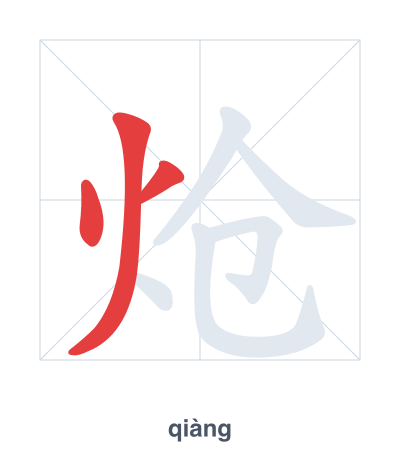
Open Hanzi Writer to see the animated stroke order and practice writing 炝 with real-time feedback.
The character 炝 (qiàng) is written with 8 strokes. Follow the standard Chinese stroke order: top to bottom, left to right, outside before inside. The radical 火 is one of its key components.
Practice the correct stroke order with the Hanzi Writer app to see animated stroke-by-stroke guidance with real-time feedback.
炝 means To quick-fry with spices.
炝 is a phono-semantic compound: the fire radical (火) hints at the high-heat cooking method, while 仓 (cāng, 'granary') provides the sound. The character visually suggests using intense fire to quickly stir-fry spices, a technique in Chinese cuisine.
💡 Memory Tip: Picture a fiery pan (火) shaped like a tiny granary (仓) where you toss sizzling spices in a quick-fry frenzy.
先用葱花炝锅。
xiān yòng cōng huā qiàng guō
First, sauté the chopped green onions to flavor the oil.
炝炒土豆丝很好吃。
qiàng chǎo tǔ dòu sī hěn hǎo chī
Quick stir-fried potato shreds are delicious.
我喜欢吃炝白菜。
wǒ xǐ huān chī qiàng bái cài
I like eating sautéed cabbage.
Open Hanzi Writer to see the animated stroke order and practice writing 炝 with real-time feedback.
✨ Animated stroke order · Handwriting recognition · HSK-graded practice · Free to use
炝 is made of two parts: the radical 火 (fire) on the left, and the phonetic component 仓 on the right. The fire radical hints at the cooking method (quick-frying using high heat), while 仓 gives the sound qiàng but also suggests speed, like a quick burst of action.